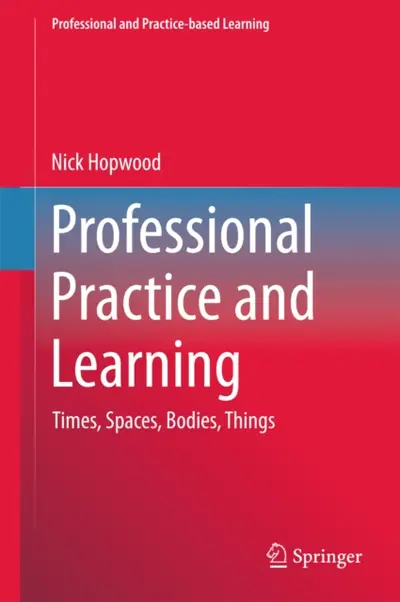
PDF · English
Professional Practice and Learning
Times, Spaces, Bodies, Things
Price and availability
$120.99
Available in: Andorra, Austria, Australia, Belgium, Bulgaria, Canada, Switzerland, Cyprus, Czechia, Germany, Denmark, Estonia, Spain, Finland, France, United Kingdom, Guernsey, Greece, Croatia, Hungary, Ireland, Isle of Man, Iceland, Italy, Jersey, Japan, Liechtenstein, Lithuania, Luxembourg, Latvia, Monaco, Malta, Netherlands, Norway, Poland, Portugal, Romania, Sweden, Slovenia, Slovakia, San Marino, United States, Vatican City, South Africa
Stores: US, UK, Canada, EU, Australia.
Sign in to buyThe price is re-checked by the server before payment.
For personal use under the eBook licence.
- Format
- DRM
- Not stated by the publisher
- Language
- English
- Publisher
- Springer International Publishing
- Published
- 22 January 2016
- ISBN
- 9783319261645
- Subjects
- Educational psychology, Teaching staff, Adult education, continuous learning, Industrial or vocational training, Teaching skills & techniques, Educational psychology, Adult education, continuous learning, Industrial or vocational training
About this book
This book explores important questions about the relationship between professional practice and learning, and implications of this for how we understand professional expertise. Focusing on work accomplished through partnerships between practitioners and parents with young children, the book explores how connectedness in action is a fluid, evolving accomplishment, with four essential dimensions: times, spaces, bodies, and things. Within a broader sociomaterial perspective, the analysis draws on practice theory and philosophy, bringing different schools of thought into productive contact, including the work of Schatzki, Gherardi, and recent developments in cultural historical activity theory. The book takes a bold view, suggesting practices and learning are entwined but distinctive phenomena. A clear and novel framework is developed, based on this idea. The argument goes further by demonstrating how new, coproductive relationships between professionals and clients can intensify thepedagogic nature of professional work, and showing how professionals can support others' learning when the knowledge they are working with, and sense of what is to be learned, are uncertain, incomplete, and fragile.
Bibliographic data © Gardners Books Ltd.