PDF · English
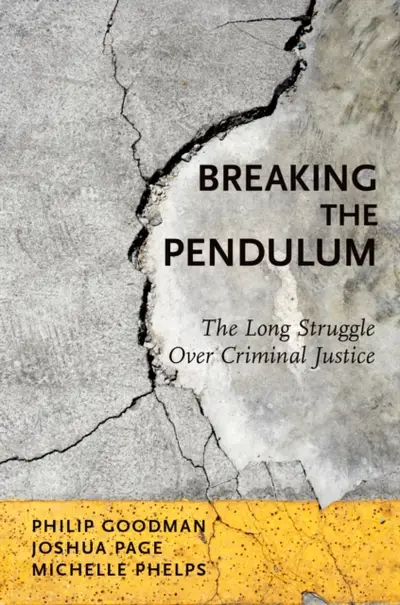
Breaking the Pendulum
The Long Struggle Over Criminal Justice
Price and availability
$32.99
Available in: Andorra, Austria, Australia, Belgium, Bulgaria, Canada, Switzerland, Cyprus, Czechia, Germany, Denmark, Estonia, Spain, Finland, France, United Kingdom, Guernsey, Greece, Croatia, Hungary, Ireland, Isle of Man, Iceland, Italy, Jersey, Japan, Liechtenstein, Lithuania, Luxembourg, Latvia, Monaco, Malta, Netherlands, Norway, Poland, Portugal, Romania, Sweden, Slovenia, Slovakia, San Marino, United States, Vatican City, South Africa
Stores: US, UK, Canada, EU, Australia.
Sign in to buyThe price is re-checked by the server before payment.
For personal use under the eBook licence.
- Format
- DRM
- Not stated by the publisher
- Language
- English
- Publisher
- Oxford University Press
- Published
- 20 March 2017
- ISBN
- 9780199976072
- Subjects
- Penology & punishment, Sentencing & punishment, Penology and punishment, Sentencing and punishment
About this book
The history of criminal justice in the U.S. is often described as a pendulum, swinging back and forth between strict punishment and lenient rehabilitation. While this view is common wisdom, it is wrong. In Breaking the Pendulum, Philip Goodman, Joshua Page, and Michelle Phelps systematically debunk the pendulum perspective, showing that it distorts how and why criminal justice changes. The pendulum model blinds us to the blending of penal orientations, policies, and practices, as well as the struggle between actors that shapes laws, institutions, and how we think about crime, punishment, and related issues. Through a re-analysis of more than two hundred years of penal history, starting with the rise of penitentiaries in the 19th Century and ending with ongoing efforts to roll back mass incarceration, the authors offer an alternative approach to conceptualizing penal development. Their agonistic perspective posits that struggle is the motor force of criminal justice history. Punishment expands, contracts, and morphs because of contestation between real people in real contexts, not a mechanical "e;swing"e; of the pendulum. This alternative framework is far more accurate and empowering than metaphors that ignore or downplay the importance of struggle in shaping criminal justice. This clearly written, engaging book is an invaluable resource for teachers, students, and scholars seeking to understand the past, present, and future of American criminal justice. By demonstrating the central role of struggle in generating major transformations, Breaking the Pendulum encourages combatants to keep fighting to change the system.
Bibliographic data © Gardners Books Ltd.