PDF · English
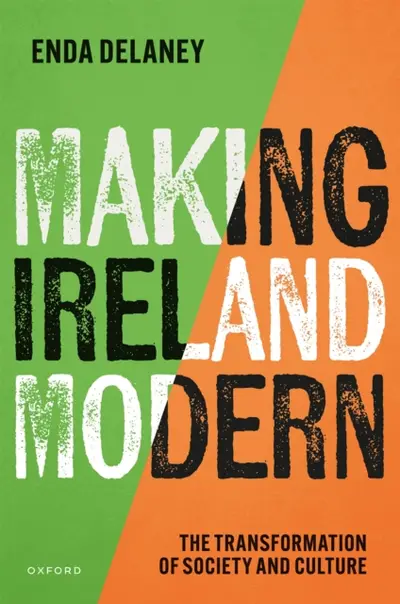
Making Ireland Modern
The Transformation of Society and Culture
Price and availability
$33.99
Available in: Andorra, Austria, Australia, Belgium, Bulgaria, Canada, Switzerland, Cyprus, Czechia, Germany, Denmark, Estonia, Spain, Finland, France, United Kingdom, Guernsey, Greece, Croatia, Hungary, Ireland, Isle of Man, Iceland, Italy, Jersey, Japan, Liechtenstein, Lithuania, Luxembourg, Latvia, Monaco, Malta, Netherlands, Norway, Poland, Portugal, Romania, Sweden, Slovenia, Slovakia, San Marino, United States, Vatican City, South Africa
Stores: US, UK, Canada, EU, Australia.
Sign in to buyThe price is re-checked by the server before payment.
For personal use under the eBook licence.
- Format
- DRM
- Not stated by the publisher
- Language
- English
- Publisher
- Oxford University Press
- Published
- 26 September 2025
- ISBN
- 9780192579874
- Subjects
- United Kingdom, Great Britain, Ireland, c 1700 to c 1800, c 1800 to c 1900, British & Irish history, Modern history to 20th century: c 1700 to c 1900, Social & cultural history, Colonialism & imperialism, European history, Social and cultural history, Colonialism and imperialism
About this book
A provocative and original reinterpretation of modern Irish history.There is a widespread misconception that Ireland became 'modern' much later than its neighbours, in the 1960s and 1970s. This is grounded in several enduring stereotypes and caricatures: of Ireland as a 'timeless' and unchanging 'land of saints and scholars'; of its society and culture in the long nineteenth century as puritanical, regressive, or archaic; of Gaelic language and culture as 'backward' or inward-looking in contrast to a 'modern' English counterpart; and of the island as natural and rural in the face of the urban and technological 'progress' of modernity. Drawing on an extensive range of sources, from poetry and novels to contemporary historical documents, acclaimed historian Enda Delaney here offers a reinterpretation of Ireland's encounter with modernity that corrects these stereotypes. By situating the island's history between 1780 and 1916 within its broader European, global, and colonial contexts, he demonstrates that Ireland's pathway to modernity was not inevitable, belated, or uni-directional: over a complex and centuries-long process it was made modern, and in its own distinctive way. This was related to, but distinct from, Ireland's complicated colonial relationship with Britain, and played out in the broader contexts of globalisation and the rise of capitalism. And at the heart of this history are the Irish people themselves, both those who lived on the island and the millions of those who left during this period and made their lives in Britain, America, Australia, and beyond, who made sense of modernity in a variety of conflicting ways and, in so doing, sought to shape their own destinies and adapt the 'old' ways of doing things in the face of relentless waves of 'progress'. Changes in values, consciousness, and beliefs interacted with broader social, political, and cultural revolutions to create a distinctive experience of becoming modern. The result is a bold and wide-ranging new history of modern Ireland that restores agency to those who lived and made its history, raising important and timely questions about modernity, globalisation, modern history, and post-colonialism.
Bibliographic data © Gardners Books Ltd.