PDF · English
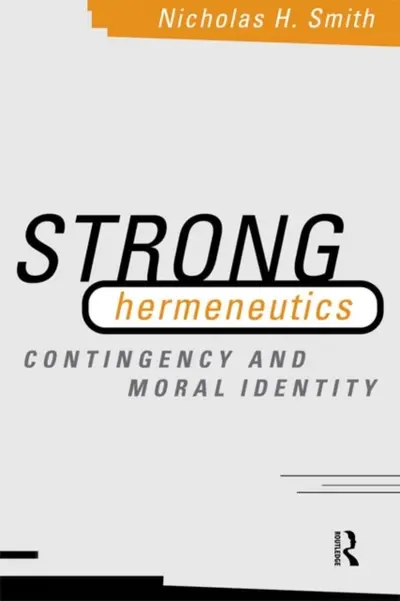
Strong Hermeneutics
Contingency and Moral Identity
Price and availability
$70.99
Available in: Andorra, Austria, Australia, Belgium, Bulgaria, Canada, Switzerland, Cyprus, Czechia, Germany, Denmark, Estonia, Spain, Finland, France, United Kingdom, Guernsey, Greece, Croatia, Hungary, Ireland, Isle of Man, Iceland, Italy, Jersey, Japan, Liechtenstein, Lithuania, Luxembourg, Latvia, Monaco, Malta, Netherlands, Norway, Poland, Portugal, Romania, Sweden, Slovenia, Slovakia, San Marino, United States, Vatican City, South Africa
Stores: US, UK, Canada, EU, Australia.
Sign in to buyThe price is re-checked by the server before payment.
For personal use under the eBook licence.
- Format
- DRM
- Not stated by the publisher
- Language
- English
- Publisher
- Taylor & Francis
- Published
- 11 September 2002
- ISBN
- 9781134712083
- Subjects
- Ethics & moral philosophy, Phenomenology and Existentialism, Ethics and moral philosophy, Environmentalist thought and ideology
About this book
Recent years have seen a resurgence of interest in ethics, particularly in the approaches of deconstruction and hermeneutics. At the same time, questions of identity have risen to prominence in philosophy and beyond into cultural studies and literature.Strong Hermeneutics is a clear and accessible investigation of both the enlightenment and postmodern or 'weak' approaches to contemporary discussions of ethics. The weak view, which can be traced back to Nietzche and seen in the recent work of Rorty and Lyotard, is sceptical of any universal principles in ethics. The enlightenment view, starting with Kant and more recently seen in the work of Habermas, views identity as subject to universal but formal moral constraints, the renewing of which is the proper task of ethics. Nicholas Smith argues that neither of these views can provide a proper framework for ethics. He puts forward a third position - a strong hermeneutics - drawing on the work of Hans-Georg Gadamer, Paul Ricoeur and Charles Taylor. Strong Hermeneutics presents a defence of this view, compares it with the realism and anti-realism debate in philosophy, and demonstrates its relevance to contemporary issues, particularly ecological responsibility.
Bibliographic data © Gardners Books Ltd.