PDF · English
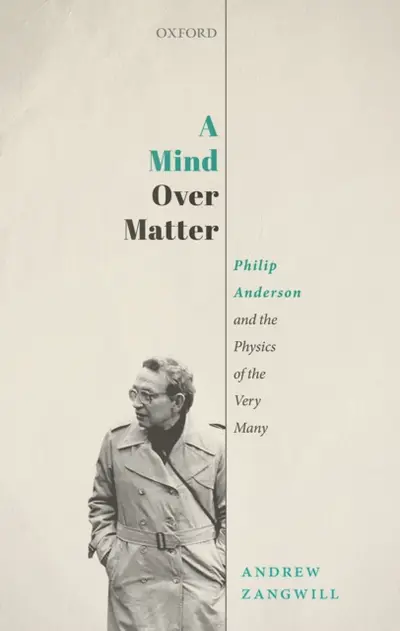
Mind Over Matter
Philip Anderson and the Physics of the Very Many
Price and availability
$31.99
Available in: Andorra, Austria, Australia, Belgium, Bulgaria, Canada, Switzerland, Cyprus, Czechia, Germany, Denmark, Estonia, Spain, Finland, France, United Kingdom, Guernsey, Greece, Croatia, Hungary, Ireland, Isle of Man, Iceland, Italy, Jersey, Japan, Liechtenstein, Lithuania, Luxembourg, Latvia, Monaco, Malta, Netherlands, Norway, Poland, Portugal, Romania, Sweden, Slovenia, Slovakia, San Marino, United States, Vatican City, South Africa
Stores: US, UK, Canada, EU, Australia.
Sign in to buyThe price is re-checked by the server before payment.
For personal use under the eBook licence.
- Format
- DRM
- Not stated by the publisher
- Language
- English
- Publisher
- Oxford University Press
- Published
- 8 January 2021
- ISBN
- 9780192640550
- Subjects
- Biography: science, technology & medicine, History of science, Materials / States of matter, Condensed matter physics (liquid state & solid state physics), History of science, Condensed matter physics (liquid state and solid state physics)
About this book
A Mind Over Matter is a biography of the Nobel-prize winner Philip W. Anderson, a person widely regarded as one of the most accomplished and influential physicists of the second half of the twentieth century. Anderson (1923-2020) was a theoretician who specialized in the physics of matter, including window glass and metals, magnets and semiconductors, liquid crystals and superconductors. More than any other single person, Anderson transformed the patchwork subject of solid-state physics into the deep, subtle, and coherent discipline known today as condensed matter physics. Among his many world-class research achievements, Anderson discovered an aspect of wave physics that had been missed by all previous scientists going back to Isaac Newton. He became a public figure when he testified before Congress to oppose its funding of an expensive project intended exclusively for particle physics research. Over the years, he published many articles designed to influence a broad audience about issues where science impacted public policy and culture. Anderson grew up in the American mid-west, was educated at Harvard, and rose to the pinnacle of his profession during the first decade of his thirty-five career as a theoretical physicist at Bell Telephone Laboratories. Almost uniquely, he spent many years working half-time as a professor at the University of Cambridge and at Princeton University. The outspoken Anderson enjoyed broad influence outside of physics when he helped develop and champion the concepts of emergence and complexity as organizing principles to help attack very difficult problems in technically challenging disciplines.
Bibliographic data © Gardners Books Ltd.