EPUB · English
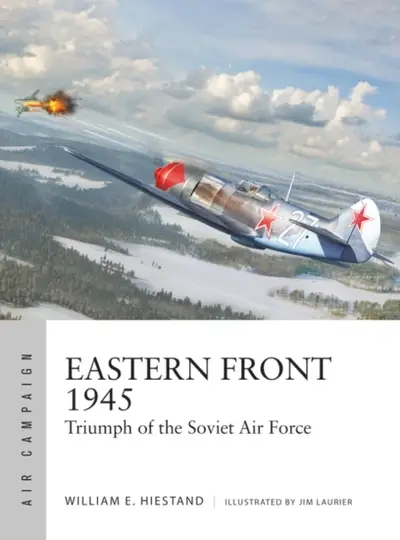
Eastern Front 1945
Triumph of the Soviet Air Force
Price and availability
$18.99
Available in: Andorra, Austria, Australia, Belgium, Bulgaria, Canada, Switzerland, Cyprus, Czechia, Germany, Denmark, Estonia, Spain, Finland, France, United Kingdom, Guernsey, Greece, Croatia, Hungary, Ireland, Isle of Man, Iceland, Italy, Jersey, Japan, Liechtenstein, Lithuania, Luxembourg, Latvia, Monaco, Malta, Netherlands, Norway, Poland, Portugal, Romania, Sweden, Slovenia, Slovakia, San Marino, United States, Vatican City, South Africa
Stores: US, UK, Canada, EU, Australia.
Sign in to buyThe price is re-checked by the server before payment.
For personal use under the eBook licence.
- Format
- EPUB
- DRM
- Not stated by the publisher
- Language
- English
- Publisher
- Bloomsbury Publishing
- Published
- 18 January 2024
- Pages
- 96
- ISBN
- 9781472857835
- Subjects
- Germany, Former Soviet Union, USSR (Europe), Russia, c 1939 to c 1945 (including WW2), 20th century history: c 1900 to c 2000, Second World War, Air forces & warfare, 3MPBLB, JWCM, NH, NHWR7
About this book
A detailed, illustrated account of the air campaign that accompanied the Red Army's final push towards Berlin, in which massed Soviet air power defeated the Luftwaffe's high-tech Me 262 jets and Mistel exploding drones. The last months of World War II on the Eastern Front saw a ferocious fight between two very different air forces. Soviet Air Force (VVS) Commander-in-Chief Alexander Novikov assembled 7,500 aircraft in three powerful air armies to support the final assault on Berlin. The Luftwaffe employed some of its most advanced weapons including the Me 262 jet and Mistel remotely-guided bomb aircraft. Using photos, 3D diagrams, maps and battlescene artwork, William E. Hiestand, a military analyst with a longstanding interest in Soviet military history, explains how Germany's use of high-tech weaponry and massed Soviet air assaults was not just the culmination of World War II air combat, but also pointed to how the future rivalry with NATO would play out. The VVS used powerful and flexible air armies to control and employ its huge force of aircraft organizational and employment concepts that would shape Soviet plans and preparations for combat during the Cold War. For the first time, this volume explains how air power helped win the war on the Eastern Front, and how victory shaped Soviet air power doctrine for the decades to come.
Bibliographic data © Gardners Books Ltd.