PDF · English
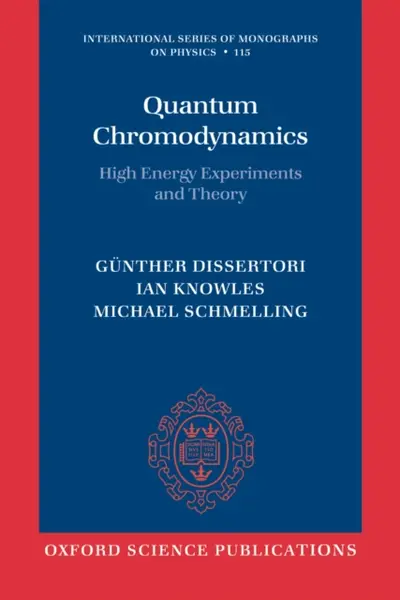
Quantum Chromodynamics
High Energy Experiments and Theory
Price and availability
$86.99
Available in: Andorra, Austria, Australia, Belgium, Bulgaria, Canada, Switzerland, Cyprus, Czechia, Germany, Denmark, Estonia, Spain, Finland, France, United Kingdom, Guernsey, Greece, Croatia, Hungary, Ireland, Isle of Man, Iceland, Italy, Jersey, Japan, Liechtenstein, Lithuania, Luxembourg, Latvia, Monaco, Malta, Netherlands, Norway, Poland, Portugal, Romania, Sweden, Slovenia, Slovakia, San Marino, United States, Vatican City, South Africa
Stores: US, UK, Canada, EU, Australia.
Sign in to buyThe price is re-checked by the server before payment.
For personal use under the eBook licence.
- Format
- DRM
- Not stated by the publisher
- Language
- English
- Publisher
- Oxford University Press
- Published
- 6 February 2003
- ISBN
- 9780191004605
- Subjects
- Cosmology & the universe, Nuclear physics, Particle & high-energy physics, Quantum physics (quantum mechanics & quantum field theory), Relativity physics, Nuclear physics, Particle and high-energy physics, Quantum physics (quantum mechanics and quantum field theory)
About this book
This book provides an introduction to Quantum Chromodynamics (QCD), the theory of strong interactions. It covers in full detail both the theoretical foundations and the experimental tests of the theory. Although the experimental chapters focus on recent measurements, the subject is placed into historical perspective by also summarizing the steps which lead to the formulation of QCD. Measurements are discussed as they were performed by the LEP experiments at CERN, or at hadron-hadron and lepton-hadron colliders such as the TEVATRON at Fermilab and HERA at DESY. Emphasis is placed on high energy tests of QCD, such as measurements of the strong coupling constant, investigations of the non-abelian structure of the underlying gauge group, determinations of nucleon structure functions, and studies of the non-perturbative hadronization process. This excellent text gives a detailed overview of how QCD developed in the 20th century and where we stand with respect to a quantitative understanding after the turn of the millenium. The text is intended for graduate and postgraduate students as well as researchers, and includes numerous problems and solutions.
Bibliographic data © Gardners Books Ltd.