PDF · English
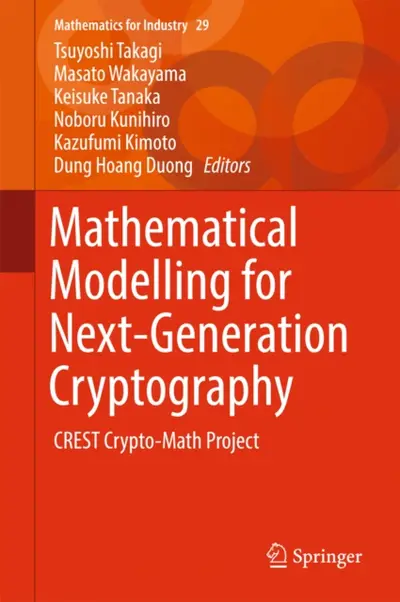
Mathematical Modelling for Next-Generation Cryptography
CREST Crypto-Math Project
Price and availability
$134.99
Available in: Andorra, Austria, Australia, Belgium, Bulgaria, Canada, Switzerland, Cyprus, Czechia, Germany, Denmark, Estonia, Spain, Finland, France, United Kingdom, Guernsey, Greece, Croatia, Hungary, Ireland, Isle of Man, Iceland, Italy, Jersey, Japan, Liechtenstein, Lithuania, Luxembourg, Latvia, Monaco, Malta, Netherlands, Norway, Poland, Portugal, Romania, Sweden, Slovenia, Slovakia, San Marino, United States, Vatican City, South Africa
Stores: US, UK, Canada, EU, Australia.
Sign in to buyThe price is re-checked by the server before payment.
For personal use under the eBook licence.
- Format
- DRM
- Not stated by the publisher
- Language
- English
- Publisher
- Springer Nature Singapore
- Published
- 25 July 2017
- ISBN
- 9789811050657
- Subjects
- Information theory, Number theory, Applied mathematics, Particle & high-energy physics, Quantum physics (quantum mechanics & quantum field theory), Engineering: general, Maths for engineers, Algorithms & data structures, Databases, Computer security, Network security, Information theory, Number theory, Particle and high-energy physics, Quantum physics (quantum mechanics and quantum field theory), Maths for engineers, Algorithms and data structures, Computer security, Network security
About this book
This book presents the mathematical background underlying security modeling in the context of next-generation cryptography. By introducing new mathematical results in order to strengthen information security, while simultaneously presenting fresh insights and developing the respective areas of mathematics, it is the first-ever book to focus on areas that have not yet been fully exploited for cryptographic applications such as representation theory and mathematical physics, among others. Recent advances in cryptanalysis, brought about in particular by quantum computation and physical attacks on cryptographic devices, such as side-channel analysis or power analysis, have revealed the growing security risks for state-of-the-art cryptographic schemes. To address these risks, high-performance, next-generation cryptosystems must be studied, which requires the further development of the mathematical background of modern cryptography. More specifically, in order to avoid the security risks posed by adversaries with advanced attack capabilities, cryptosystems must be upgraded, which in turn relies on a wide range of mathematical theories. This book is suitable for use in an advanced graduate course in mathematical cryptography, while also offering a valuable reference guide for experts.
Bibliographic data © Gardners Books Ltd.