PDF · English
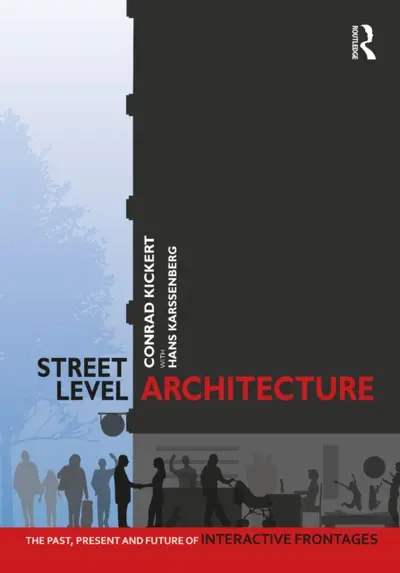
Street-Level Architecture
The Past, Present and Future of Interactive Frontages
Price and availability
$51.99
Available in: Andorra, Austria, Australia, Belgium, Bulgaria, Canada, Switzerland, Cyprus, Czechia, Germany, Denmark, Estonia, Spain, Finland, France, United Kingdom, Guernsey, Greece, Croatia, Hungary, Ireland, Isle of Man, Iceland, Italy, Jersey, Japan, Liechtenstein, Lithuania, Luxembourg, Latvia, Monaco, Malta, Netherlands, Norway, Poland, Portugal, Romania, Sweden, Slovenia, Slovakia, San Marino, United States, Vatican City, South Africa
Stores: US, UK, Canada, EU, Australia.
Sign in to buyThe price is re-checked by the server before payment.
For personal use under the eBook licence.
- Format
- DRM
- Not stated by the publisher
- Language
- English
- Publisher
- Taylor & Francis
- Published
- 4 August 2022
- ISBN
- 9781000603347
- Subjects
- Architecture: professional practice, Public buildings: civic, commercial, industrial, etc, City & town planning - architectural aspects, Urban & municipal planning, Europe, North America (USA and Canada), Architecture: public, commercial and industrial buildings, City and town planning: architectural aspects, Urban and municipal planning and policy
About this book
This book provides the tools to maintain and rebuild the interaction between architecture and public space. Despite the best intentions of designers and planners, interactive frontages have dwindled over the past century in Europe and North America. This book demonstrates why even our best intentions for interactive frontages are currently unable to turn a swelling tide of economic and technological evolution, land consolidation, introversion, stratification, and contagious decline. It uses these lessons to offer concrete locational, programming, design, and management strategies to maximize street-level interaction and trust between street-level architecture, its inhabitants, and the city. This book demonstrates that designers, developers, planners, and managers ultimately have to create the right preconditions for inhabitants and passersby to bring frontages to life. These preconditions connect architecture to its urban, social, economical, and technological context. Only the right frontage in the right context, with the right design, the right inhabitation, and the right attitude to the city will become part of the ecosystem of trust and interaction that supports public life. This book empowers the many participants in this ecosystem to build, inhabit, and enjoy truly urbane architecture.
Bibliographic data © Gardners Books Ltd.