PDF · English
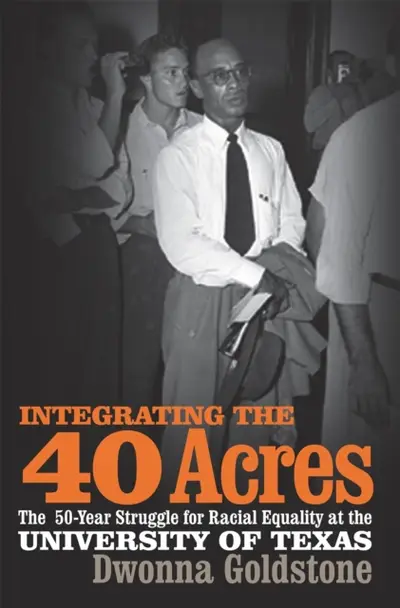
Integrating the 40 Acres
The Fifty-Year Struggle for Racial Equality at the University of Texas
Price and availability
Price unavailable
Available in: Andorra, Austria, Australia, Belgium, Bulgaria, Canada, Switzerland, Cyprus, Czechia, Germany, Denmark, Estonia, Spain, Finland, France, United Kingdom, Guernsey, Greece, Croatia, Hungary, Ireland, Isle of Man, Iceland, Italy, Jersey, Japan, Liechtenstein, Lithuania, Luxembourg, Latvia, Monaco, Malta, Netherlands, Norway, Poland, Portugal, Romania, Sweden, Slovenia, Slovakia, San Marino, United States, Vatican City, South Africa
Stores: US, UK, Canada, EU, Australia.
This title cannot be bought in this store yet: its supplier terms, territorial rights or price are still being confirmed.
For personal use under the eBook licence.
- Format
- DRM
- Not stated by the publisher
- Language
- English
- Publisher
- University of Georgia Press
- Published
- 15 January 2012
- ISBN
- 9780820342030
- Subjects
- USA, Texas, c 1945 to c 2000 (Post-war period), History of the Americas, Black & Asian studies, Education, Universities, Civil rights & citizenship, United States of America, USA, 1KBB-US-SWT, 3MPQ, JBSL, Education / Educational sciences / Pedagogy, JNM, JPVC, NHK
About this book
You name it, we can't do it. That was how one African American student at the University of Texas at Austin summed up his experiences in a 1960 newspaper article-some ten years after the beginning of court-mandated desegregation at the school. In this first full-length history of the university's desegregation, Dwonna Goldstone examines how, for decades, administrators only gradually undid the most visible signs of formal segregation while putting their greatest efforts into preventing true racial integration. In response to the 1956 Board of Regents decision to admit African American undergraduates, for example, the dean of students and the director of the student activities center stopped scheduling dances to prevent racial intermingling in a social setting.Goldstone's coverage ranges from the 1950 U.S. Supreme Court ruling that the University of Texas School of Law had to admit Heman Sweatt, an African American, through the 1994 Hopwood v. Texas decision, which ended affirmative action in the state's public institutions of higher education. She draws on oral histories, university documents, and newspaper accounts to detail how the university moved from open discrimination to foot-dragging acceptance to mixed successes in the integration of athletics, classrooms, dormitories, extracurricular activities, and student recruitment. Goldstone incorporates not only the perspectives of university administrators, students, alumni, and donors, but also voices from all sides of the civil rights movement at the local and national level. This instructive story of power, race, money, and politics remains relevant to the modern university and the continuing question about what it means to be integrated.
Bibliographic data © Gardners Books Ltd.