EPUB · English
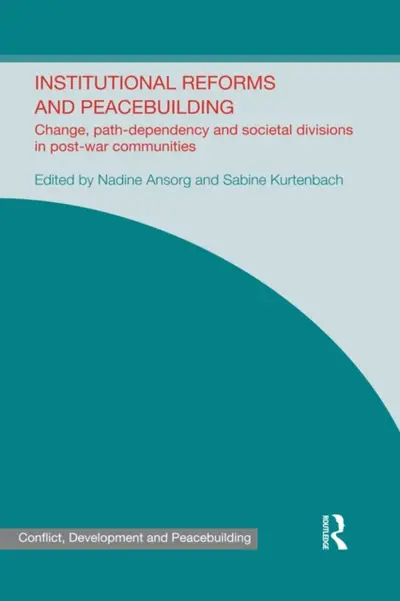
Institutional Reforms and Peacebuilding
Change, Path-Dependency and Societal Divisions in Post-War Communities
Price and availability
$63.99
Available in: Andorra, Austria, Australia, Belgium, Bulgaria, Canada, Switzerland, Cyprus, Czechia, Germany, Denmark, Estonia, Spain, Finland, France, United Kingdom, Guernsey, Greece, Croatia, Hungary, Ireland, Isle of Man, Iceland, Italy, Jersey, Japan, Liechtenstein, Lithuania, Luxembourg, Latvia, Monaco, Malta, Netherlands, Norway, Poland, Portugal, Romania, Sweden, Slovenia, Slovakia, San Marino, United States, Vatican City, South Africa
Stores: US, UK, Canada, EU, Australia.
Sign in to buyThe price is re-checked by the server before payment.
For personal use under the eBook licence.
- Format
- EPUB
- DRM
- Not stated by the publisher
- Language
- English
- Publisher
- Taylor & Francis
- Published
- 13 September 2016
- ISBN
- 9781134820146
- Subjects
- Peace studies & conflict resolution, Military history, Politics & government, International relations, Peace studies and conflict resolution, Police and security services, Public administration / Public policy
About this book
This book deals with the question how institutional reform can contribute to peacebuilding in post-war and divided societies. In the context of armed conflict and widespread violence, two important questions shape political agendas inside and outside the affected societies: How can we stop the violence? And how can we prevent its recurrence? Comprehensive negotiated war terminations and peace accords recommend a set of mechanisms to bring an end to war and establish peace, including institutional reforms that promote democratization and state building. Although the role of institutions is widely recognized, their specific effects are highly contested in research as well as in practice. This book highlights the necessity to include path-dependency, pre-conflict institutions and societal divisions to understand the patterns of institutional change in post-war societies and the ongoing risk of civil war recurrence. It focuses on the general question of how institutional reform contributes to the establishment of peace in post-war societies. This book comprises three separate but interrelated parts on the relation between institutions and societal divisions, on institutional reform and on security sector reform. The chapters contribute to the understanding of the relationship between societal cleavages, pre-conflict institutions, path dependency, and institutional reform.This book will be of much interest to students of peacebuilding, conflict resolution, development studies, security studies and IR.
Bibliographic data © Gardners Books Ltd.