EPUB · English
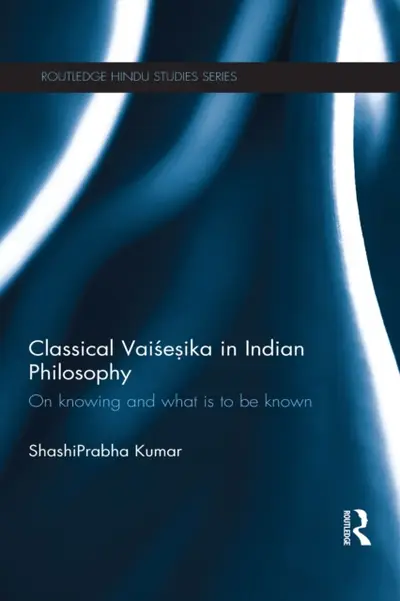
Classical Vaisesika in Indian Philosophy
On Knowing and What is to Be Known
Price and availability
$78.99
Available in: Andorra, Austria, Australia, Belgium, Bulgaria, Canada, Switzerland, Cyprus, Czechia, Germany, Denmark, Estonia, Spain, Finland, France, United Kingdom, Guernsey, Greece, Croatia, Hungary, Ireland, Isle of Man, Iceland, Italy, Jersey, Japan, Liechtenstein, Lithuania, Luxembourg, Latvia, Monaco, Malta, Netherlands, Norway, Poland, Portugal, Romania, Sweden, Slovenia, Slovakia, San Marino, United States, Vatican City, South Africa
Stores: US, UK, Canada, EU, Australia.
Sign in to buyThe price is re-checked by the server before payment.
For personal use under the eBook licence.
- Format
- EPUB
- DRM
- Not stated by the publisher
- Language
- English
- Publisher
- Taylor & Francis
- Published
- 2 September 2013
- ISBN
- 9781135071097
- Subjects
- Indian sub-continent, India, Regional studies, Oriental & Indian philosophy, Religion: general, Hinduism, India, East Asian and Indian philosophy, Philosophy: epistemology and theory of knowledge
About this book
Vaisesika is one of the six systems of Hindu philosophy. It represents a pluralistic realism and is usually held to be an atomistic, metaphysical theory. This book explores the basic tenets of the Vaisesika classical school of Indian philosophy from a new perspective. It argues that it reveals an epistemological formulation of its own, which was diminished due to later developments in the history of Indian philosophical tradition.Focusing on the principles of knowable objects and the processes of knowing as propounded by the Vaisesika school of Indian Philosophy, the book offers a fuller appreciation of the theories. Providing a balanced approach by examining earliest available material in the original sources of Vaisesika and concentrating on the epistemological pattern adopted therein, it presents an authentic and comprehensive understanding of Vaisesika concepts. This is the first introductory sourcebook in English for the authentic study of Vaisesika, and is of use to students and scholars of World Religion and Philosophy.
Bibliographic data © Gardners Books Ltd.