EPUB · English
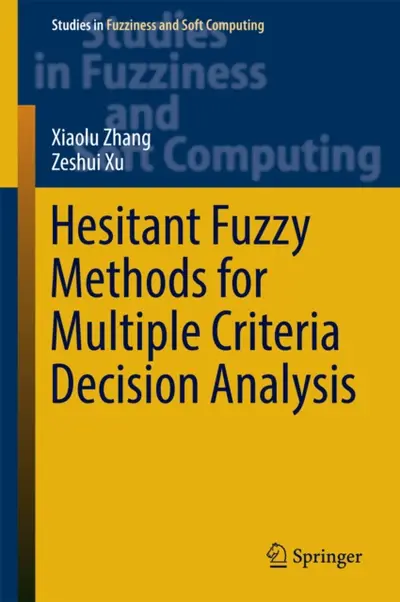
Hesitant Fuzzy Methods for Multiple Criteria Decision Analysis
Price and availability
$120.99
Available in: Andorra, Austria, Australia, Belgium, Bulgaria, Canada, Switzerland, Cyprus, Czechia, Germany, Denmark, Estonia, Spain, Finland, France, United Kingdom, Guernsey, Greece, Croatia, Hungary, Ireland, Isle of Man, Iceland, Italy, Jersey, Japan, Liechtenstein, Lithuania, Luxembourg, Latvia, Monaco, Malta, Netherlands, Norway, Poland, Portugal, Romania, Sweden, Slovenia, Slovakia, San Marino, United States, Vatican City, South Africa
Stores: US, UK, Canada, EU, Australia.
Sign in to buyThe price is re-checked by the server before payment.
For personal use under the eBook licence.
- Format
- EPUB
- DRM
- Not stated by the publisher
- Language
- English
- Publisher
- Springer International Publishing
- Published
- 8 October 2016
- ISBN
- 9783319420011
- Subjects
- Management & management techniques, Business mathematics & systems, Operational research, Engineering: general, Artificial intelligence, Neural networks & fuzzy systems, Management decision making, Operational research, Artificial intelligence (AI)
About this book
The book offers a comprehensive introduction to methods for solving multiple criteria decision making and group decision making problems with hesitant fuzzy information. It reports on the authors' latest research, as well as on others' research, providing readers with a complete set of decision making tools, such as hesitant fuzzy TOPSIS, hesitant fuzzy TODIM, hesitant fuzzy LINMAP, hesitant fuzzy QUALIFEX, and the deviation modeling approach with heterogeneous fuzzy information. The main focus is on decision making problems in which the criteria values and/or the weights of criteria are not expressed in crisp numbers but are more suitable to be denoted as hesitant fuzzy elements. The largest part of the book is devoted to new methods recently developed by the authors to solve decision making problems in situations where the available information is vague or hesitant. These methods are presented in detail, together with their application to different type of decision-making problems. All in all, the book represents a valuable reference guide for graduate students and researchers in the both fields of fuzzy logic and decision making.
Bibliographic data © Gardners Books Ltd.