EPUB · English
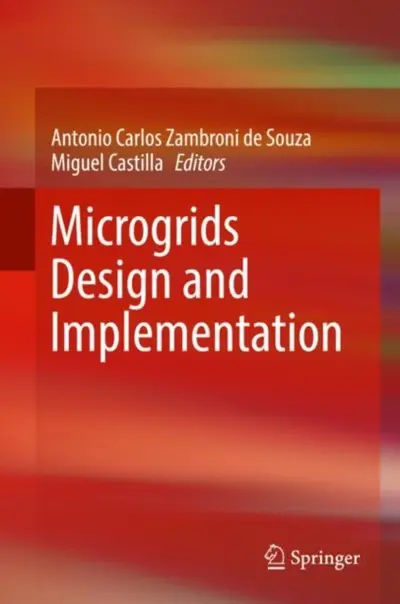
Microgrids Design and Implementation
Price and availability
$215.99
Available in: Andorra, Austria, Australia, Belgium, Bulgaria, Canada, Switzerland, Cyprus, Czechia, Germany, Denmark, Estonia, Spain, Finland, France, United Kingdom, Guernsey, Greece, Croatia, Hungary, Ireland, Isle of Man, Iceland, Italy, Jersey, Japan, Liechtenstein, Lithuania, Luxembourg, Latvia, Monaco, Malta, Netherlands, Norway, Poland, Portugal, Romania, Sweden, Slovenia, Slovakia, San Marino, United States, Vatican City, South Africa
Stores: US, UK, Canada, EU, Australia.
Sign in to buyThe price is re-checked by the server before payment.
For personal use under the eBook licence.
- Format
- EPUB
- DRM
- Not stated by the publisher
- Language
- English
- Publisher
- Springer International Publishing
- Published
- 29 November 2018
- ISBN
- 9783319986876
- Subjects
- Ethics & moral philosophy, Environmental economics, Energy industries & utilities, Electrical engineering, Power networks, systems, stations & plants, Alternative & renewable energy sources & technology, Energy industries and utilities, Ethics and moral philosophy, Electrical engineering, Alternative and renewable energy sources and technology
About this book
This book addresses the emerging trend of smart grids in power systems. It discusses the advent of smart grids and selected technical implications; further, by combining the perspectives of researchers from Europe and South America, the book captures the status quo of and approaches to smart grids in a wide range of countries. It describes the basic concepts, enabling readers to understand the theoretical aspects behind smart grid formation, while also examining current challenges and philosophical discussions. Like the industrial revolution and the birth of the Internet, smart grids are certain to change the way people use electricity. In this regard, a new term - the "e;prosumer"e; - is used to describe consumers who may sometimes also be energy producers. This is particularly appealing if we bear in mind that most of the distributed power generation in smart grids does not involve carbon emissions. At first glance, the option of generating their own power couldmove consumers to leave their current energy provider. Yet the authors argue that doing so is not a wise choice: utilities will play a central role in this new scenario and should not be ignored.
Bibliographic data © Gardners Books Ltd.