EPUB · English
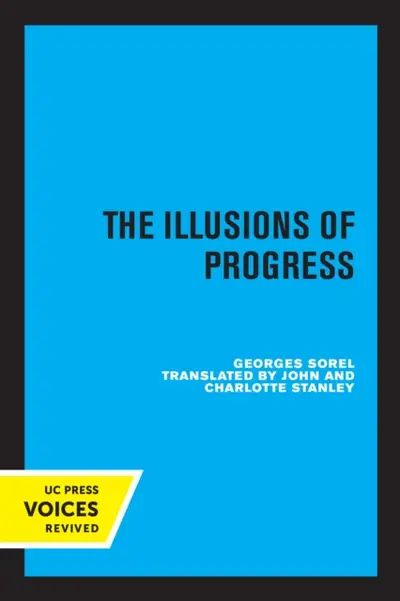
Illusions of Progress
Price and availability
$27.99
Available in: Andorra, Austria, Australia, Belgium, Bulgaria, Canada, Switzerland, Cyprus, Czechia, Germany, Denmark, Estonia, Spain, Finland, France, United Kingdom, Guernsey, Greece, Croatia, Hungary, Ireland, Isle of Man, Iceland, Italy, Jersey, Japan, Liechtenstein, Lithuania, Luxembourg, Latvia, Monaco, Malta, Netherlands, Norway, Poland, Portugal, Romania, Sweden, Slovenia, Slovakia, San Marino, United States, Vatican City, South Africa
Stores: US, UK, Canada, EU, Australia.
Sign in to buyThe price is re-checked by the server before payment.
For personal use under the eBook licence.
- Format
- EPUB
- DRM
- Not stated by the publisher
- Language
- English
- Publisher
- University of California Press
- Published
- 1 January 1969
- ISBN
- 9780520323872
- Subjects
- History, Political science & theory, Political science and theory, History
About this book
Georges Sorel's The Illusions of Progress critically examines the modern concept of progress, tracing its origins to Enlightenment-era rationalism and exposing its role as an ideological construct serving bourgeois interests. Sorel argues that progress, often presented as an inevitable and universal force driving human betterment, is in reality a tool of social and political domination. This ideology fosters complacency, legitimizes the power of ruling elites, and stifles genuine moral and revolutionary vigor. By conflating progress with virtue, modern society undermines its own moral foundations, replacing meaningful action and struggle with passive acceptance of a deterministic historical narrative. Sorel critiques both liberal democracy and parliamentary socialism for perpetuating this illusion of progress while entrenching the same elite structures that have dominated society across different eras. To counter the stifling effects of progressivism, Sorel advocates for revolutionary myths, such as the general strike, which inspire moral renewal and action through their emotive and imaginative power. Unlike rigid ideologies, myths remain adaptable and rooted in human creativity, fostering the kind of virtuous struggle that Sorel admires in periods of historical greatness, such as ancient Greece or the early Roman Republic. Despite his critique of progress, Sorel acknowledges the potential for material improvement in production, championing innovation driven by autonomous producers rather than bureaucratic control. Ultimately, he sees progress not as a natural law or moral imperative, but as an ideological weapon of the status quo, masking social inequalities and preventing the transformative energy needed for true societal renewal. This title is part of UC Press's Voices Revived program, which commemorates University of California Press's mission to seek out and cultivate the brightest minds and give them voice, reach, and impact. Drawing on a backlist dating to 1893, Voices Revived makes high-quality, peer-reviewed scholarship accessible once again using print-on-demand technology. This title was originally published in 1969.Many titles in the Voices Revived program are also newly available as ebooks, offered at a discounted price to support wider access to scholarly work.</DIV
Bibliographic data © Gardners Books Ltd.