PDF · English
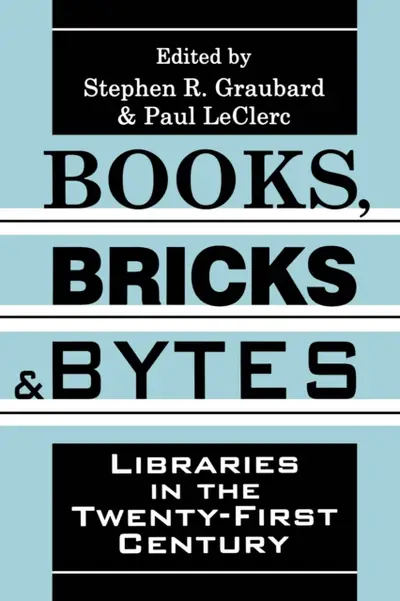
Books, Bricks and Bytes
Libraries in the Twenty-first Century
Price and availability
$68.99
Available in: Andorra, Austria, Australia, Belgium, Bulgaria, Canada, Switzerland, Cyprus, Czechia, Germany, Denmark, Estonia, Spain, Finland, France, United Kingdom, Guernsey, Greece, Croatia, Hungary, Ireland, Isle of Man, Iceland, Italy, Jersey, Japan, Liechtenstein, Lithuania, Luxembourg, Latvia, Monaco, Malta, Netherlands, Norway, Poland, Portugal, Romania, Sweden, Slovenia, Slovakia, San Marino, United States, Vatican City, South Africa
Stores: US, UK, Canada, EU, Australia.
Sign in to buyThe price is re-checked by the server before payment.
For personal use under the eBook licence.
- Format
- DRM
- Not stated by the publisher
- Language
- English
- Publisher
- Taylor & Francis
- Published
- 5 July 2017
- ISBN
- 9781351531016
- Subjects
- Library & information services, Sociology, France, Germany, Russia, India, Republic of South Africa, United States of America, USA, IT, Internet and electronic resources in libraries, Bibliographic and subject control, Library and information services, Archiving, preservation and digitization
About this book
Libraries are experiencing a technological revolution that goes well beyond anything that has existed since the invention of printing. Not surprisingly, the digital library, with all that it portends for the future of the book and the periodical, but also with all that it implies for the kinds of information that will be collected and disseminated, will necessarily preoccupy those responsible for libraries in the new century. Everything from copyright, access, and cost to the nature of the reading public itself is now up for re-examination.'Books, Bricks, and Bytes' brings together an extraordinary array of authors at the cutting edge of these concerns, not only within the United States, but experts drawn from Germany, France, Russia, the United Kingdom, Brazil, and India. James H. Billington discusses the Library of Congress in the information age; Ann S. Okerson outlines two models for securing scholarly information; Donald S. Lamm discusses the shaky partnership of publishers and librarians hi this new environment; Klaus-Dieter Lehmann provides a framework for maintaining the intellectual heritage of the past in a digitized future. Each contributor shows hi concrete detail and vivid illustration that the library as a world of holdings is increasingly valued as an incomparable place to access information. In his preface to the book, Stephen Graubard reminds us that whether or not one believes in the reality of the information revolution that is said to be overtaking the world, it is obvious that the libraries being built today do not resemble those marble sanctuaries constructed hi the Victorian age or in the early twentieth entury. This is a work that shows how libraries have been transformed from "e;refuges"e; from the external world, to places that reflect the social and intellectual values of specific societies. The idea that the library is a public trust and public resource is at the center of this unusually fine collection at the cutting edge of professional and public life.
Bibliographic data © Gardners Books Ltd.