EPUB · English
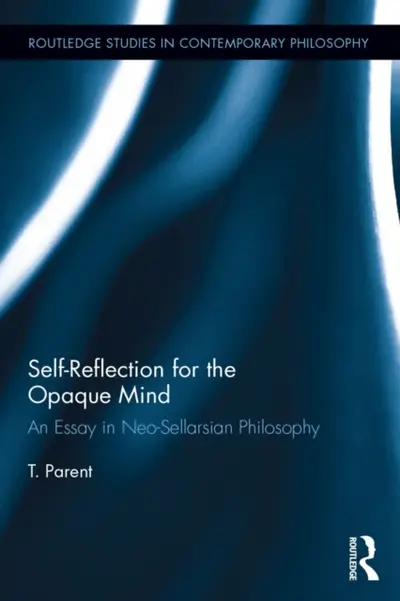
Self-Reflection for the Opaque Mind
An Essay in Neo-Sellarsian Philosophy
Price and availability
$64.99
Available in: Andorra, Austria, Australia, Belgium, Bulgaria, Canada, Switzerland, Cyprus, Czechia, Germany, Denmark, Estonia, Spain, Finland, France, United Kingdom, Guernsey, Greece, Croatia, Hungary, Ireland, Isle of Man, Iceland, Italy, Jersey, Japan, Liechtenstein, Lithuania, Luxembourg, Latvia, Monaco, Malta, Netherlands, Norway, Poland, Portugal, Romania, Sweden, Slovenia, Slovakia, San Marino, United States, Vatican City, South Africa
Stores: US, UK, Canada, EU, Australia.
Sign in to buyThe price is re-checked by the server before payment.
For personal use under the eBook licence.
- Format
- EPUB
- DRM
- Not stated by the publisher
- Language
- English
- Publisher
- Taylor & Francis
- Published
- 1 December 2016
- ISBN
- 9781317210955
- Subjects
- Philosophy of language, Philosophy, Philosophy: epistemology & theory of knowledge, Philosophy of mind, Cognition & cognitive psychology, Philosophy: epistemology and theory of knowledge, Philosophy of mind
About this book
This volume attempts to solve a grave problem about critical self-reflection. The worry is that we critical thinkers are all in "e;epistemic bad faith"e; in light of what psychology tells us. After all, the research shows not merely that we are bad at detecting "e;ego-threatening"e; thoughts a la Freud. It also indicates that we are ignorant of even our ordinary thoughts-e.g., reasons for our moral judgments of others (Haidt 2001), and even mundane reasons for buying one pair of stockings over another! (Nisbett & Wilson 1977) However, reflection on one's thoughts requires knowing what those thoughts are in the first place. So if ignorance is the norm, why attempt self-reflection? The activity would just display naivety about psychology. Yet while respecting all the data, this book argues that, remarkably, we are sometimes infallible in our self-discerning judgments. Even so, infallibility does not imply indubitability, and there is no Cartesian ambition to provide a "e;foundation"e; for empirical knowledge. The point is rather to explain how self-reflection as a rational activity is possible.
Bibliographic data © Gardners Books Ltd.