PDF · English
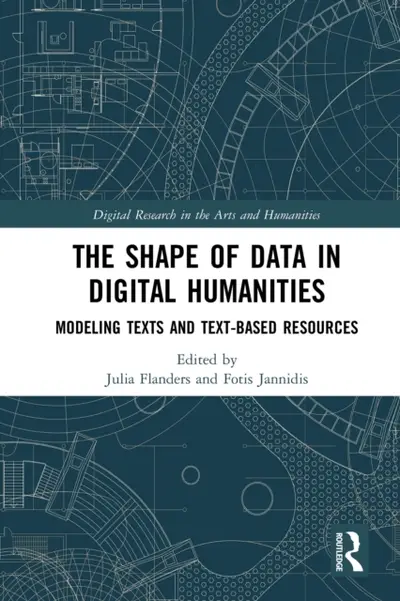
Shape of Data in Digital Humanities
Modeling Texts and Text-based Resources
Price and availability
$64.99
Available in: Andorra, Austria, Australia, Belgium, Bulgaria, Canada, Switzerland, Cyprus, Czechia, Germany, Denmark, Estonia, Spain, Finland, France, United Kingdom, Guernsey, Greece, Croatia, Hungary, Ireland, Isle of Man, Iceland, Italy, Jersey, Japan, Liechtenstein, Lithuania, Luxembourg, Latvia, Monaco, Malta, Netherlands, Norway, Poland, Portugal, Romania, Sweden, Slovenia, Slovakia, San Marino, United States, Vatican City, South Africa
Stores: US, UK, Canada, EU, Australia.
Sign in to buyThe price is re-checked by the server before payment.
For personal use under the eBook licence.
- Format
- DRM
- Not stated by the publisher
- Language
- English
- Publisher
- Taylor & Francis
- Published
- 2 November 2018
- ISBN
- 9781317016151
- Subjects
- Library & information sciences, Library, archive & information management, History, Data capture & analysis, Data warehousing, Computer science, Computer modelling & simulation, Database design and theory, Digital Humanities / Computer applications in the arts and humanities
About this book
Data and its technologies now play a large and growing role in humanities research and teaching. This book addresses the needs of humanities scholars who seek deeper expertise in the area of data modeling and representation. The authors, all experts in digital humanities, offer a clear explanation of key technical principles, a grounded discussion of case studies, and an exploration of important theoretical concerns. The book opens with an orientation, giving the reader a history of data modeling in the humanities and a grounding in the technical concepts necessary to understand and engage with the second part of the book. The second part of the book is a wide-ranging exploration of topics central for a deeper understanding of data modeling in digital humanities. Chapters cover data modeling standards and the role they play in shaping digital humanities practice, traditional forms of modeling in the humanities and how they have been transformed by digital approaches, ontologies which seek to anchor meaning in digital humanities resources, and how data models inhabit the other analytical tools used in digital humanities research. It concludes with a glossary chapter that explains specific terms and concepts for data modeling in the digital humanities context. This book is a unique and invaluable resource for teaching and practising data modeling in a digital humanities context.
Bibliographic data © Gardners Books Ltd.