PDF · English
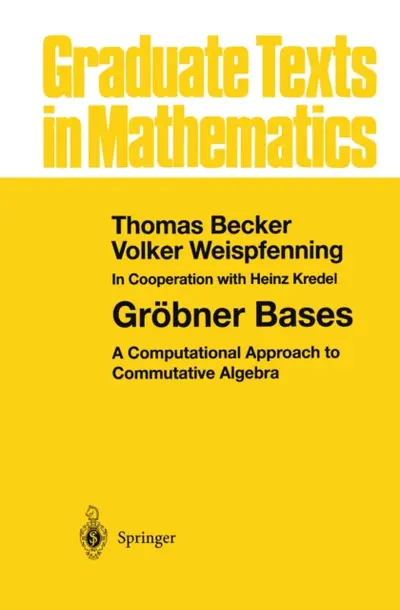
Grobner Bases
A Computational Approach to Commutative Algebra
Price and availability
$95.99
Available in: Andorra, Austria, Australia, Belgium, Bulgaria, Canada, Switzerland, Cyprus, Czechia, Germany, Denmark, Estonia, Spain, Finland, France, United Kingdom, Guernsey, Greece, Croatia, Hungary, Ireland, Isle of Man, Iceland, Italy, Jersey, Japan, Liechtenstein, Lithuania, Luxembourg, Latvia, Monaco, Malta, Netherlands, Norway, Poland, Portugal, Romania, Sweden, Slovenia, Slovakia, San Marino, United States, Vatican City, South Africa
Stores: US, UK, Canada, EU, Australia.
Sign in to buyThe price is re-checked by the server before payment.
For personal use under the eBook licence.
- Format
- DRM
- Not stated by the publisher
- Language
- English
- Publisher
- Springer New York
- Published
- 6 December 2012
- ISBN
- 9781461209133
- Subjects
- Algebra, Groups & group theory, Algebra, Groups and group theory
About this book
The origins of the mathematics in this book date back more than two thou- sand years, as can be seen from the fact that one of the most important algorithms presented here bears the name of the Greek mathematician Eu- clid. The word "e;algorithm"e; as well as the key word "e;algebra"e; in the title of this book come from the name and the work of the ninth-century scientist Mohammed ibn Musa al-Khowarizmi, who was born in what is now Uzbek- istan and worked in Baghdad at the court of Harun al-Rashid's son. The word "e;algorithm"e; is actually a westernization of al-Khowarizmi's name, while "e;algebra"e; derives from "e;al-jabr,"e; a term that appears in the title of his book Kitab al-jabr wa'l muqabala, where he discusses symbolic methods for the solution of equations. This close connection between algebra and al- gorithms lasted roughly up to the beginning of this century; until then, the primary goal of algebra was the design of constructive methods for solving equations by means of symbolic transformations. During the second half of the nineteenth century, a new line of thought began to enter algebra from the realm of geometry, where it had been successful since Euclid's time, namely, the axiomatic method.
Bibliographic data © Gardners Books Ltd.