PDF · English
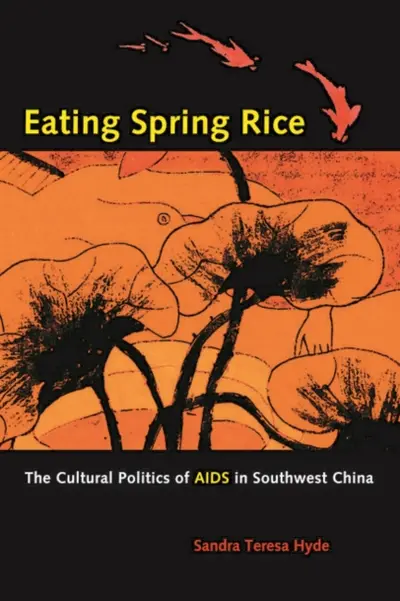
Eating Spring Rice
The Cultural Politics of AIDS in Southwest China
Price and availability
$40.99
Available in: Andorra, Austria, Australia, Belgium, Bulgaria, Canada, Switzerland, Cyprus, Czechia, Germany, Denmark, Estonia, Spain, Finland, France, United Kingdom, Guernsey, Greece, Croatia, Hungary, Ireland, Isle of Man, Iceland, Italy, Jersey, Japan, Liechtenstein, Lithuania, Luxembourg, Latvia, Monaco, Malta, Netherlands, Norway, Poland, Portugal, Romania, Sweden, Slovenia, Slovakia, San Marino, United States, Vatican City, South Africa
Stores: US, UK, Canada, EU, Australia.
Sign in to buyThe price is re-checked by the server before payment.
For personal use under the eBook licence.
- Format
- DRM
- Not stated by the publisher
- Language
- English
- Publisher
- University of California Press
- Published
- 16 January 2007
- ISBN
- 9780520939486
- Subjects
- China, HIV / AIDS: social aspects, Anthropology, Social & cultural anthropology, ethnography, Diseases & disorders, Anthropology, Social and cultural anthropology, Diseases and disorders
About this book
Eating Spring Rice is the first major ethnographic study of HIV/AIDS in China. Drawing on more than a decade of ethnographic research (1995-2005), primarily in Yunnan Province, Sandra Teresa Hyde chronicles the rise of the HIV epidemic from the years prior to the Chinese government's acknowledgement of this public health crisis to post-reform thinking about infectious-disease management. Hyde combines innovative public health research with in-depth ethnography on the ways minorities and sex workers were marked as the principle carriers of HIV, often despite evidence to the contrary.Hyde approaches HIV/AIDS as a study of the conceptualization and the circulation of a disease across boundaries that requires different kinds of anthropological thinking and methods. She focuses on "e;everyday AIDS practices"e; to examine the links between the material and the discursive representations of HIV/AIDS. This book illustrates how representatives of the Chinese government singled out a former kingdom of Thailand, Sipsongpanna, and its indigenous ethnic group, the Tai-Lue, as carriers of HIV due to a history of prejudice and stigma, and to the geography of the borderlands. Hyde poses questions about the cultural politics of epidemics, state-society relations, Han and non-Han ethnic dynamics, and the rise of an AIDS public health bureaucracy in the post-reform era.
Bibliographic data © Gardners Books Ltd.