PDF · English
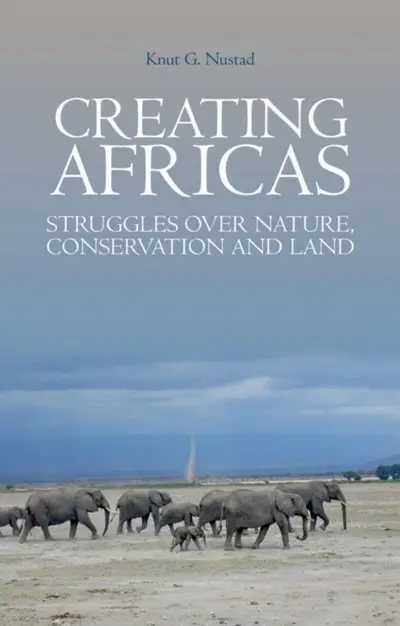
Creating Africas
Struggles Over Nature, Conservation and Land
Price and availability
$15.99
Available in: Andorra, Austria, Australia, Belgium, Bulgaria, Canada, Switzerland, Cyprus, Czechia, Germany, Denmark, Estonia, Spain, Finland, France, United Kingdom, Guernsey, Greece, Croatia, Hungary, Ireland, Isle of Man, Iceland, Italy, Jersey, Japan, Liechtenstein, Lithuania, Luxembourg, Latvia, Monaco, Malta, Netherlands, Norway, Poland, Portugal, Romania, Sweden, Slovenia, Slovakia, San Marino, United States, Vatican City, South Africa
Stores: US, UK, Canada, EU, Australia.
Sign in to buyThe price is re-checked by the server before payment.
For personal use under the eBook licence.
- Format
- DRM
- Not stated by the publisher
- Language
- English
- Publisher
- Oxford University Press
- Published
- 21 May 2015
- ISBN
- 9781849045957
- Subjects
- Africa, Developing countries, Development studies, African history, Animals & society, Conservation of the environment, Global South / Developing countries, Reception or Interpretation studies / Audience Theory, JBFU, NHH, Conservation of the environment
About this book
In Africa, conflicts between protected areas for fauna and flora and space for their surrounding human populations continue despite years spent trying to find an accommodation between the needs of both parties. Creating Africas investigates the roots of the current conservation boom, demonstrates that it is part of a struggle over various definitions of existing realities, and examines the global effects of this struggle. The book discusses the first UNESCO World Heritage Site in South Africa, the Isimangaliso (St Lucia) Wetland Park. Here, conservation interests are pitted against those of industrial forestry, commercial farming, and local communities struggling to have their lands returned to them. They all seek to define and create their own realities, but do so with very different resources at their disposal. In his expert analysis, Nustad treats these realities not as different representations but rather as multiple, often competing, viewpoints that involve a wide range of actors, both human and non-human. Nustad posits that in order to avoid being accused of neo-colonial land grabbing, the conservation lobby will need to find a new way of imagining nature and protection that includes people.
Bibliographic data © Gardners Books Ltd.