PDF · English
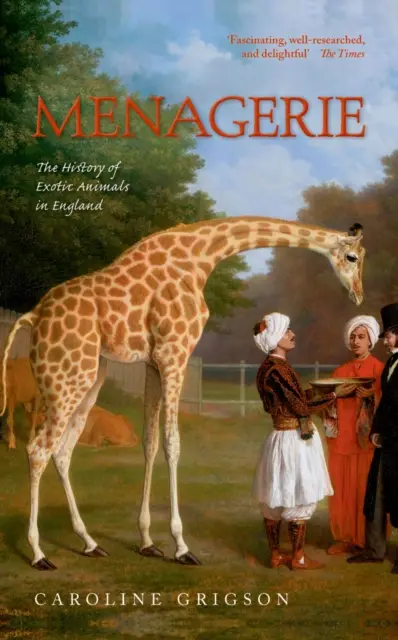
Menagerie
The History of Exotic Animals in England
Price and availability
$16.99
Available in: Andorra, Austria, Australia, Belgium, Bulgaria, Canada, Switzerland, Cyprus, Czechia, Germany, Denmark, Estonia, Spain, Finland, France, United Kingdom, Guernsey, Greece, Croatia, Hungary, Ireland, Isle of Man, Iceland, Italy, Jersey, Japan, Liechtenstein, Lithuania, Luxembourg, Latvia, Monaco, Malta, Netherlands, Norway, Poland, Portugal, Romania, Sweden, Slovenia, Slovakia, San Marino, United States, Vatican City, South Africa
Stores: US, UK, Canada, EU, Australia.
Sign in to buyThe price is re-checked by the server before payment.
For personal use under the eBook licence.
- Format
- DRM
- Not stated by the publisher
- Language
- English
- Publisher
- Oxford University Press
- Published
- 29 January 2016
- ISBN
- 9780191024115
- Subjects
- England, Modern period, c 1500 onwards, British & Irish history, Social & cultural history, History of science, Popular science, Zoology & animal sciences, England, European history, Social and cultural history, History of science, Popular science, Zoology and animal sciences
About this book
Menagerie is the story of the panoply of exotic animals that were brought into Britain from time immemorial until the foundation of the London Zoo -- a tale replete with the extravagant, the eccentric, and -- on occasion -- the downright bizarre. From Henry III's elephant at the Tower, to George IV's love affair with Britain's first giraffe and Lady Castlereagh's recalcitrant ostriches, Caroline Grigson's tour through the centuries amounts to the first detailed history of exotic animals in Britain. On the way we encounter a host of fascinating and outlandish creatures, including the first peacocks and popinjays, Thomas More's monkey, James I's cassowaries in St James's Park, and Lord Clive's zebra -- which refused to mate with a donkey, until the donkey was painted with stripes. But this is not just the story of the animals themselves. It also the story of all those who came into contact with them: the people who owned them, the merchants who bought and sold them, the seamen who carried them to our shores, the naturalists who wrote about them, the artists who painted them, the itinerant showmen who worked with them, the collectors who collected them. And last but not least, it is about all those who simply came to see and wonder at them, from kings, queens, and nobles to ordinary men, women, and children, often impelled by no more than simple curiosity and a craving for novelty.
Bibliographic data © Gardners Books Ltd.