PDF · English
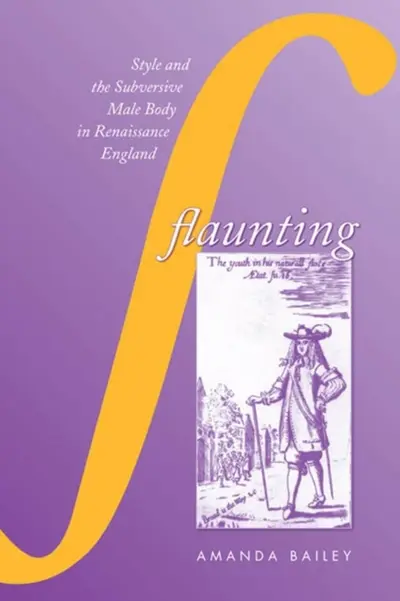
Flaunting
Price and availability
$32.99
Available in: Andorra, Austria, Australia, Belgium, Bulgaria, Canada, Switzerland, Cyprus, Czechia, Germany, Denmark, Estonia, Spain, Finland, France, United Kingdom, Guernsey, Greece, Croatia, Hungary, Ireland, Isle of Man, Iceland, Italy, Jersey, Japan, Liechtenstein, Lithuania, Luxembourg, Latvia, Monaco, Malta, Netherlands, Norway, Poland, Portugal, Romania, Sweden, Slovenia, Slovakia, San Marino, United States, Vatican City, South Africa
Stores: US, UK, Canada, EU, Australia.
Sign in to buyThe price is re-checked by the server before payment.
For personal use under the eBook licence.
- Format
- DRM
- Not stated by the publisher
- Language
- English
- Publisher
- University of Toronto Press
- Published
- 31 December 2007
- Pages
- 196
- ISBN
- 9781442684348
- Subjects
- Europe, United Kingdom, Great Britain, Fashion & textiles: design, History of fashion, Theatre studies, Literary studies: c 1500 to c 1800, British & Irish history, Early modern history: c 1450/1500 to c 1700, Social & cultural history, Cultural studies, Fashion and textile design, ATD, Literary studies: c 1600 to c 1800, JBCC, NH, NHD, NHTB
About this book
In the early modern period, the theatrical stage offered one of the most popular forms of entertainment and aesthetic pleasure. It also fulfilled an important cultural function by displaying modes of behaviour and dramatizing social interaction within a community. Flaunting argues that the theatre in late sixteenth-century England created the conditions for a subculture of style whose members came to distinguish themselves by their sartorial extravagance and social impudence.Drawing on evidence from legal documents, economic treatises, domestic manuals, accounts of playhouse practices, and stage plays, Amanda Bailey critiques standard accounts maintaining that those who flaunted their apparel were simply aspirants, or gaudy versions of the superiors they sought to emulate. Instead, she suggests that what mattered most was not what these young men wore but how they wore their clothes. These young men shared a distinctive sartorial sensibility and used that sensibility to undermine authority at all levels of society. Flaunting therefore, examines male style as a visual form of subversion against the norms of Renaissance England with the stage as the primary source of inspiration for collective identification.A glimpse into both the celebration of and opposition to social irreverence in the early modern period, Flaunting is a fascinating historical account of drama, fashion, and rebellion with surprisingly close parallels to the contemporary world.
Bibliographic data © Gardners Books Ltd.