PDF · English
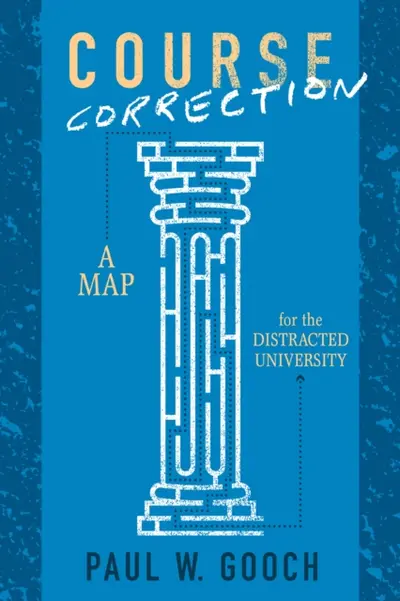
Course Correction
A Map for the Distracted University
Price and availability
$33.99
Available in: Andorra, Austria, Australia, Belgium, Bulgaria, Canada, Switzerland, Cyprus, Czechia, Germany, Denmark, Estonia, Spain, Finland, France, United Kingdom, Guernsey, Greece, Croatia, Hungary, Ireland, Isle of Man, Iceland, Italy, Jersey, Japan, Liechtenstein, Lithuania, Luxembourg, Latvia, Monaco, Malta, Netherlands, Norway, Poland, Portugal, Romania, Sweden, Slovenia, Slovakia, San Marino, United States, Vatican City, South Africa
Stores: US, UK, Canada, EU, Australia.
Sign in to buyThe price is re-checked by the server before payment.
For personal use under the eBook licence.
- Format
- DRM
- Not stated by the publisher
- Language
- English
- Publisher
- University of Toronto Press
- Published
- 1 March 2019
- Pages
- 312
- ISBN
- 9781487531126
- Subjects
- Humanities, History, Philosophy, Popular philosophy, Education, Organization & management of education, Schools, Independent schools, private education, Faith (religious) schools, Extra-curricular activities, Educational visits & field trips, Advice on education, Education / Educational sciences / Pedagogy, Educational administration and organization, Schools and pre-schools, Independent schools, private education, Faith (religious) schools, Extra-curricular activities, NH, QD, QDX, Advice on education
About this book
Course Correction engages in deliberation about what the twenty-first-century university needs to do in order to re-find its focus as a protected place for unfettered commitment to knowledge, not just as a space for creating employment or economic prosperity. The university's business, Paul W. Gooch writes, is to generate and critique knowledge claims, and to transmit and certify the acquisition of knowledge. In order to achieve this, a university must have a reputation for integrity and trustworthiness, and this, in turn, requires a diligent and respectful level of autonomy from state, religion, and other powerful influences. It also requires embracing the challenges of academic freedom and the effective governance of an academic community.Course Correction raises three important questions about the twenty-first-century university. In discussing the dominant attention to student experience, the book asks, "e;Is it now all about students?"e; Secondly, in questioning "e;What knowledge should undergraduates gain?"e; it provides a critique of undergraduate experience, advocating a Socratic approach to education as interrogative conversation. Finally, by asking "e;What and where are well-placed universities?"e; the book makes the case against placeless education offered in the digital world, in favour of education that takes account of its place in time and space.
Bibliographic data © Gardners Books Ltd.