PDF · English
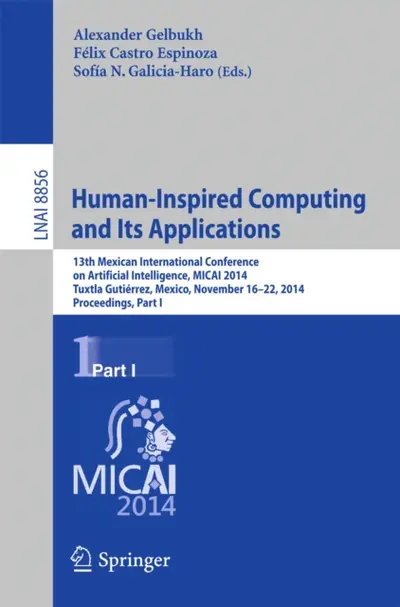
Human-Inspired Computing and its Applications
13th Mexican International Conference on Artificial Intelligence, MICAI2014, Tuxtla Gutiérrez, Mexico, November 16-22, 2014. Proceedings, Part I
Price and availability
$60.99
Available in: Andorra, Austria, Australia, Belgium, Bulgaria, Canada, Switzerland, Cyprus, Czechia, Germany, Denmark, Estonia, Spain, Finland, France, United Kingdom, Guernsey, Greece, Croatia, Hungary, Ireland, Isle of Man, Iceland, Italy, Jersey, Japan, Liechtenstein, Lithuania, Luxembourg, Latvia, Monaco, Malta, Netherlands, Norway, Poland, Portugal, Romania, Sweden, Slovenia, Slovakia, San Marino, United States, Vatican City, South Africa
Stores: US, UK, Canada, EU, Australia.
Sign in to buyThe price is re-checked by the server before payment.
For personal use under the eBook licence.
- Format
- DRM
- Not stated by the publisher
- Language
- English
- Publisher
- Springer International Publishing
- Published
- 5 November 2014
- ISBN
- 9783319136479
- Subjects
- Health & safety aspects of IT, Algorithms & data structures, Information retrieval, Computer vision, Algorithms and data structures, Data warehousing, Information retrieval, Applied computing, Computer applications in industry and technology, Artificial intelligence (AI), Image processing
About this book
The two-volume set LNAI 8856 and LNAI 8857 constitutes the proceedings of the 13th Mexican International Conference on Artificial Intelligence, MICAI 2014, held in Tuxtla, Mexico, in November 2014. The total of 87 papers plus 1 invited talk presented in these proceedings were carefully reviewed and selected from 348 submissions. The first volume deals with advances in human-inspired computing and its applications. It contains 44 papers structured into seven sections: natural language processing, natural language processing applications, opinion mining, sentiment analysis, and social network applications, computer vision, image processing, logic, reasoning, and multi-agent systems, and intelligent tutoring systems. The second volume deals with advances in nature-inspired computation and machine learning and contains also 44 papers structured into eight sections: genetic and evolutionary algorithms, neural networks, machine learning, machine learning applications to audio and text, data mining, fuzzy logic, robotics, planning, and scheduling, and biomedical applications.
Bibliographic data © Gardners Books Ltd.