PDF · English
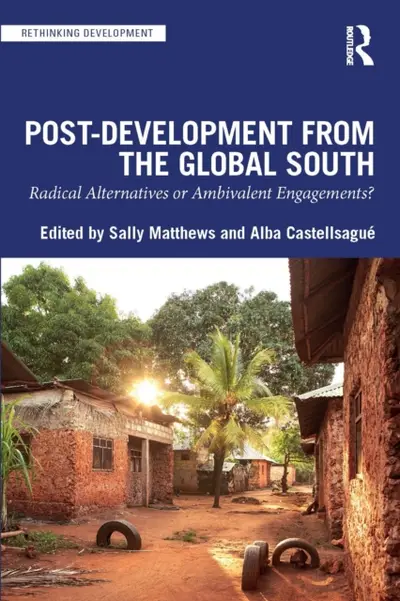
Post-Development from the Global South
Radical Alternatives or Ambivalent Engagements?
- History
- Society & social sciences
- Politics & law
- Nature, environment & geography
- Philosophy & religion
- Reference
Price and availability
$59.99
Available in: Andorra, Austria, Australia, Belgium, Bulgaria, Canada, Switzerland, Cyprus, Czechia, Germany, Denmark, Estonia, Spain, Finland, France, United Kingdom, Guernsey, Greece, Croatia, Hungary, Ireland, Isle of Man, Iceland, Italy, Jersey, Japan, Liechtenstein, Lithuania, Luxembourg, Latvia, Monaco, Malta, Netherlands, Norway, Poland, Portugal, Romania, Sweden, Slovenia, Slovakia, San Marino, United States, Vatican City, South Africa
Stores: US, UK, Canada, EU, Australia.
Sign in to buyThe price is re-checked by the server before payment.
For personal use under the eBook licence.
- Format
- DRM
- Not stated by the publisher
- Language
- English
- Publisher
- Taylor & Francis
- Published
- 25 April 2025
- ISBN
- 9781040341971
- Subjects
- Developing countries, Development studies, Colonialism & imperialism, Philosophy: epistemology & theory of knowledge, Cultural studies, Ethnic studies, Sociology: customs & traditions, Social & cultural anthropology, ethnography, Human geography, Regional geography, World, Cultural studies, Social and cultural anthropology, Indigenous people: governance and politics
About this book
Post-development advocates and decolonial thinkers are calling for radical alternatives to development, but how do these ideals sit with the day-to-day reality of marginalised communities struggling with poverty, precarity, and the deprivation of human rights?This book investigates how post-development alternatives are being understood and negotiated on the ground in the Global South. Indigenous concepts and practices attributed to people in the Global South are seen by post-development thinkers as offering transformative alternatives to dominant development models of progress and economic growth. For example, buen vivir from particular regions of South America points to a 'culture of life' and ubuntu in Southern Africa emphasises human connectedness and mutuality. Such terms are associated with social and environmental sustainability, and a greater connection to Southern epistemologies. Drawing on extensive fieldwork, this book takes us directly to Global South communities from around the world, to consider the complex ways in which they negotiate the ideas and practices associated with (post)development, and their views on the supposed indigenous alternatives. The book encourages a contextual approach that embraces the tensions and contradictions that exist within different communities.Taking the reader from abstract post-development theory right into the heart of communities directly impacted by development, this book will be an important guide for students, researchers and practitioners looking for better ways to address the desires and aspirations of marginalised communities in the Global South.
Bibliographic data © Gardners Books Ltd.