PDF · English
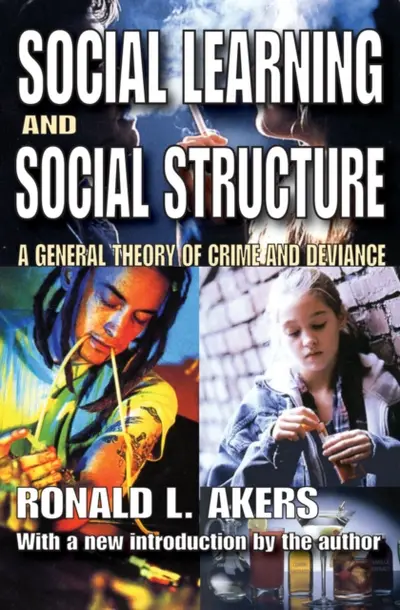
Social Learning and Social Structure
A General Theory of Crime and Deviance
Price and availability
$68.99
Available in: Andorra, Austria, Australia, Belgium, Bulgaria, Canada, Switzerland, Cyprus, Czechia, Germany, Denmark, Estonia, Spain, Finland, France, United Kingdom, Guernsey, Greece, Croatia, Hungary, Ireland, Isle of Man, Iceland, Italy, Jersey, Japan, Liechtenstein, Lithuania, Luxembourg, Latvia, Monaco, Malta, Netherlands, Norway, Poland, Portugal, Romania, Sweden, Slovenia, Slovakia, San Marino, United States, Vatican City, South Africa
Stores: US, UK, Canada, EU, Australia.
Sign in to buyThe price is re-checked by the server before payment.
For personal use under the eBook licence.
- Format
- DRM
- Not stated by the publisher
- Language
- English
- Publisher
- Taylor & Francis
- Published
- 28 July 2017
- ISBN
- 9781351490153
- Subjects
- Social issues & processes, Sociology, Crime & criminology, Causes & prevention of crime, Social theory, Causes and prevention of crime, Behaviourism, Behavioural theory
About this book
The social learning theory of crime integrates Edwin H. Sutherland's diff erential association theory with behavioral learning theory. It is a widely accepted and applied approaches to criminal and deviant behavior. However, it is also widely misinterpreted, misstated, and misapplied.This is the fi rst single volume, in-depth, authoritative discussion of the background, concepts, development, modifications, and empirical tests of social learning theory. Akers begins with a personal account of Sutherland's involvement in criminology and the origins of his infl uential perspective. He then traces the intellectual history of Sutherland's theory as well as social learning theory, providing a comprehensive explanation of how each theory approaches illegal behavior. Akers reviews research on various correlates and predictors of crime and delinquency that may be used as operational measures of differential association, reinforcement, and other social learning concepts.Akers proposes a new, integrated theory of social learning and social structure that links group diff erences in crime to individual conduct. He concludes with a cogent discussion of the implications of social learning theory for criminology and public policy. Now available in paperback, with a new introduction by the author, this volume will be invaluable to professionals and for use in courses in criminology and deviance.
Bibliographic data © Gardners Books Ltd.