PDF · English
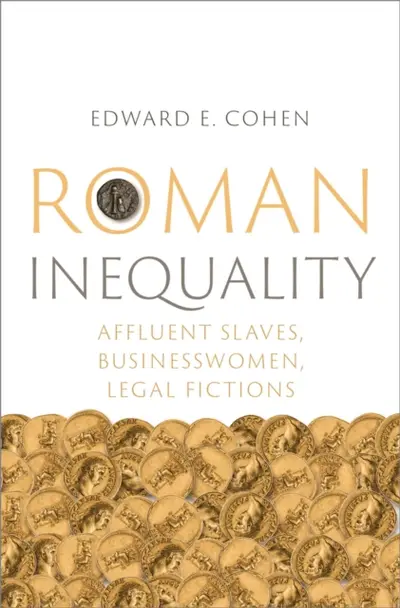
Roman Inequality
Affluent Slaves, Businesswomen, Legal Fictions
Price and availability
$56.99
Available in: Andorra, Austria, Australia, Belgium, Bulgaria, Canada, Switzerland, Cyprus, Czechia, Germany, Denmark, Estonia, Spain, Finland, France, United Kingdom, Guernsey, Greece, Croatia, Hungary, Ireland, Isle of Man, Iceland, Italy, Jersey, Japan, Liechtenstein, Lithuania, Luxembourg, Latvia, Monaco, Malta, Netherlands, Norway, Poland, Portugal, Romania, Sweden, Slovenia, Slovakia, San Marino, United States, Vatican City, South Africa
Stores: US, UK, Canada, EU, Australia.
Sign in to buyThe price is re-checked by the server before payment.
For personal use under the eBook licence.
- Format
- DRM
- Not stated by the publisher
- Language
- English
- Publisher
- Oxford University Press
- Published
- 26 May 2023
- ISBN
- 9780197687369
- Subjects
- Ancient Rome, General & world history, Ancient history: to c 500 CE, Economic history, Roman law, 1QBAR, Economic history, Systems of law: Roman law, NHB, NHC
About this book
Roman Inequality explores how in Rome in the first and second centuries CE a number of male and female slaves, and some free women, prospered in business amidst a population of generally impoverished free inhabitants and of impecunious enslaved residents. Edward E. Cohen focuses on two anomalies to which only minimal academic attention has been previously directed: (1) the paradox of a Roman economy dependent on enslaved entrepreneurs who functioned, and often achieved considerable personal affluence, within a legal system that supposedly deprived unfree persons of all legal capacity and human rights; (2) the incongruity of the importance and accomplishments of Roman businesswomen, both free and slave, successfully operating under legal rules that in many aspects discriminated against women, but in commercial matters were in principle gender-blind and in practice generated egalitarian juridical conditions that often trumped gender-discriminatory customs. This book also examines the casuistry through which Roman jurists created "e;legal fictions"e; facilitating a commercial reality utterly incompatible with the fundamental precepts--inherently discriminatory against women and slaves---that Roman legal experts ("e;jurisprudents"e;) continued explicitly to insist upon. Moreover, slaves' acquisition of wealth was actually aided by a surprising preferential orientation of the legal system: Roman law--to modern Western eyes counter-intuitively--in reality privileged servile enterprise, to the detriment of free enterprise. Beyond its anticipated audience of economic historians and students and scholars of classical antiquity, especially of Roman history and law, Roman Inequality will appeal to all persons working on or interested in gender and liberation issues.
Bibliographic data © Gardners Books Ltd.