PDF · English
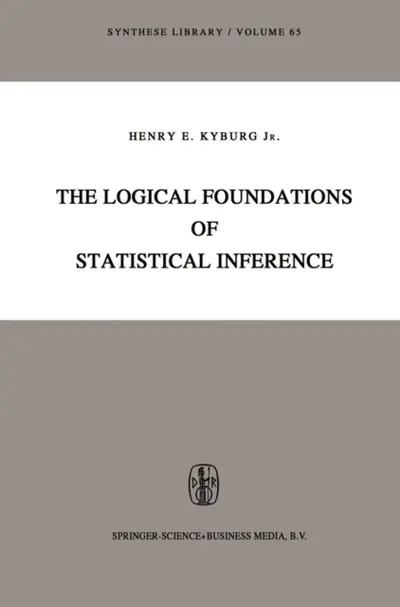
Logical Foundations of Statistical Inference
Price and availability
$175.99
Available in: Andorra, Austria, Australia, Belgium, Bulgaria, Canada, Switzerland, Cyprus, Czechia, Germany, Denmark, Estonia, Spain, Finland, France, United Kingdom, Guernsey, Greece, Croatia, Hungary, Ireland, Isle of Man, Iceland, Italy, Jersey, Japan, Liechtenstein, Lithuania, Luxembourg, Latvia, Monaco, Malta, Netherlands, Norway, Poland, Portugal, Romania, Sweden, Slovenia, Slovakia, San Marino, United States, Vatican City, South Africa
Stores: US, UK, Canada, EU, Australia.
Sign in to buyThe price is re-checked by the server before payment.
For personal use under the eBook licence.
- Format
- DRM
- Not stated by the publisher
- Language
- English
- Publisher
- Springer Netherlands
- Published
- 6 December 2012
- ISBN
- 9789401021753
- Subjects
- Philosophy: logic, Philosophy: logic
About this book
Everyone knows it is easy to lie with statistics. It is important then to be able to tell a statistical lie from a valid statistical inference. It is a relatively widely accepted commonplace that our scientific knowledge is not certain and incorrigible, but merely probable, subject to refinement, modifi- cation, and even overthrow. The rankest beginner at a gambling table understands that his decisions must be based on mathematical ex- pectations - that is, on utilities weighted by probabilities. It is widely held that the same principles apply almost all the time in the game of life. If we turn to philosophers, or to mathematical statisticians, or to probability theorists for criteria of validity in statistical inference, for the general principles that distinguish well grounded from ill grounded generalizations and laws, or for the interpretation of that probability we must, like the gambler, take as our guide in life, we find disagreement, confusion, and frustration. We might be prepared to find disagreements on a philosophical and theoretical level (although we do not find them in the case of deductive logic) but we do not expect, and we may be surprised to find, that these theoretical disagreements lead to differences in the conclusions that are regarded as 'acceptable' in the practice of science and public affairs, and in the conduct of business.
Bibliographic data © Gardners Books Ltd.