EPUB · English
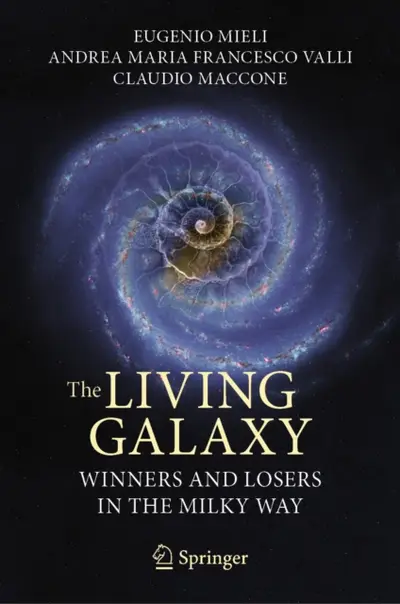
Living Galaxy
Winners and Losers in the Milky Way
Price and availability
$74.99
Available in: Andorra, Austria, Australia, Belgium, Bulgaria, Canada, Switzerland, Cyprus, Czechia, Germany, Denmark, Estonia, Spain, Finland, France, United Kingdom, Guernsey, Greece, Croatia, Hungary, Ireland, Isle of Man, Iceland, Italy, Jersey, Japan, Liechtenstein, Lithuania, Luxembourg, Latvia, Monaco, Malta, Netherlands, Norway, Poland, Portugal, Romania, Sweden, Slovenia, Slovakia, San Marino, United States, Vatican City, South Africa
Stores: US, UK, Canada, EU, Australia.
Sign in to buyThe price is re-checked by the server before payment.
For personal use under the eBook licence.
- Format
- EPUB
- DRM
- Not stated by the publisher
- Language
- English
- Publisher
- Springer Nature Switzerland
- Published
- 14 February 2025
- ISBN
- 9783031673245
- Subjects
- Astronomy, space & time, Astrophysics, Biology, life sciences, Astronomy, space and time, Biology, life sciences
About this book
This book describes the possible distribution of life in the Milky Way. Our description is mathematical in order to be extrapolated from what we know that happened on Earth to what might have happened on the huge number of extrasolar planets existing in the Milky Way Galaxy. We use the statistical Drake equation, which identifies parameters for calculating the total number of life forms at all levels. While the original Drake equation (1961) contained seven factors only, we extend the number of factors to 50, thus incorporating much of the scientific knowledge about the Evolution of Life available in 2024.As such, this book aims at being a narrative of a series of events, starting with pre-life epochs and extending them into the present and into the future. This book, while well rooted in scientific and mathematical models, depicts the drama of life - whether it emerges and thrives or succumbs and vanishes. It's a tale of attempts, defeats, and progress, unfolding not along the scale of Human Lifetimes, but rather along the scale of Galactic Civilizations billion years long.
Bibliographic data © Gardners Books Ltd.