PDF · English
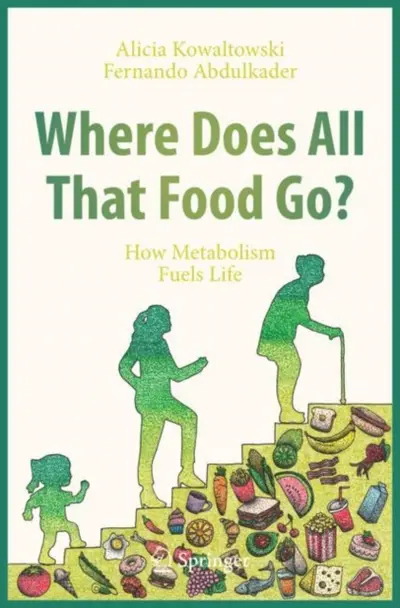
Where Does All That Food Go?
How Metabolism Fuels Life
Price and availability
$37.99
Available in: Andorra, Austria, Australia, Belgium, Bulgaria, Canada, Switzerland, Cyprus, Czechia, Germany, Denmark, Estonia, Spain, Finland, France, United Kingdom, Guernsey, Greece, Croatia, Hungary, Ireland, Isle of Man, Iceland, Italy, Jersey, Japan, Liechtenstein, Lithuania, Luxembourg, Latvia, Monaco, Malta, Netherlands, Norway, Poland, Portugal, Romania, Sweden, Slovenia, Slovakia, San Marino, United States, Vatican City, South Africa
Stores: US, UK, Canada, EU, Australia.
Sign in to buyThe price is re-checked by the server before payment.
For personal use under the eBook licence.
- Format
- DRM
- Not stated by the publisher
- Language
- English
- Publisher
- Springer International Publishing
- Published
- 14 August 2020
- ISBN
- 9783030509682
- Subjects
- Medicine: general issues, Physiology, Pathology, Biology, life sciences, Life sciences: general issues, Human biology, Medicine / Healthcare: general issues / topics, Physiology, Pathology, Life sciences: general issues
About this book
Most of us eat (or incorporate into our bodies) quite a bit of stuff that does not look, act or function even remotely like us. Unless our food mysteriously disappears inside of us, this must mean we change its molecular structure in some way. In fact, we are constantly modifying our molecules through chemical reactions, which together constitute our Metabolism. At any given moment, we transform (metabolize) millions of molecules within our bodies, building new ones, breaking down others, and exchanging them with the world around us. Metabolism is much more than the reason you gain weight when you overeat, it is a process that is so central for life that it defines what a living being is.We will explore what metabolism is, how these chemical reactions that constitute Metabolism are organized and how they are regulated (including the effects of hormones). We will follow the transformations of each type of nutrient (carbohydrates, proteins and lipids) within our bodies and cells, from the mouth, through our intestines and then within the different organs in our body. We will discuss metabolic and evolutionary reasons why so many people today struggle with excessive weight gain, and why some (rarer) people find it hard to gain weight, even when eating large amounts. We will also discuss changes in metabolism with diseases such as diabetes and heart attack, as well as conditions such as exercise and aging.
Bibliographic data © Gardners Books Ltd.