PDF · English
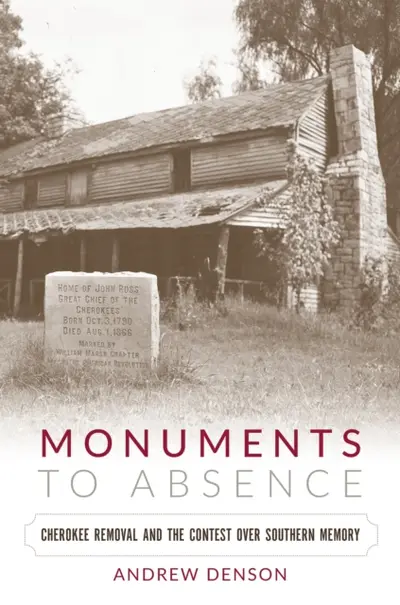
Monuments to Absence
Cherokee Removal and the Contest over Southern Memory
Price and availability
$155.99
Available in: Andorra, Austria, Australia, Belgium, Bulgaria, Canada, Switzerland, Cyprus, Czechia, Germany, Denmark, Estonia, Spain, Finland, France, United Kingdom, Guernsey, Greece, Croatia, Hungary, Ireland, Isle of Man, Iceland, Italy, Jersey, Japan, Liechtenstein, Lithuania, Luxembourg, Latvia, Monaco, Malta, Netherlands, Norway, Poland, Portugal, Romania, Sweden, Slovenia, Slovakia, San Marino, United States, Vatican City, South Africa
Stores: US, UK, Canada, EU, Australia.
Sign in to buyThe price is re-checked by the server before payment.
For personal use under the eBook licence.
- Format
- DRM
- Not stated by the publisher
- Language
- English
- Publisher
- The University of North Carolina Press
- Published
- 20 February 2017
- ISBN
- 9781469630854
- Subjects
- USA, Southeastern & South Atlantic states, Central Southern states, History of the Americas, Social & cultural history, Indigenous peoples, US South, Indigenous peoples / Indigeneity, History of the Americas, Social and cultural history, Local history
About this book
The 1830s forced removal of Cherokees from their southeastern homeland became the most famous event in the Indian history of the American South, an episode taken to exemplify a broader experience of injustice suffered by Native peoples. In this book, Andrew Denson explores the public memory of Cherokee removal through an examination of memorials, historic sites, and tourist attractions dating from the early twentieth century to the present. White southerners, Denson argues, embraced the Trail of Tears as a story of Indian disappearance. Commemorating Cherokee removal affirmed white possession of southern places, while granting them the moral satisfaction of acknowledging past wrongs. During segregation and the struggle over black civil rights, removal memorials reinforced whites' authority to define the Souths past and present. Cherokees, however, proved capable of repossessing the removal memory, using it for their own purposes during a time of crucial transformation in tribal politics and U.S. Indian policy. In considering these representations of removal, Denson brings commemoration of the Indian past into the broader discussion of race and memory in the South.
Bibliographic data © Gardners Books Ltd.