PDF · English
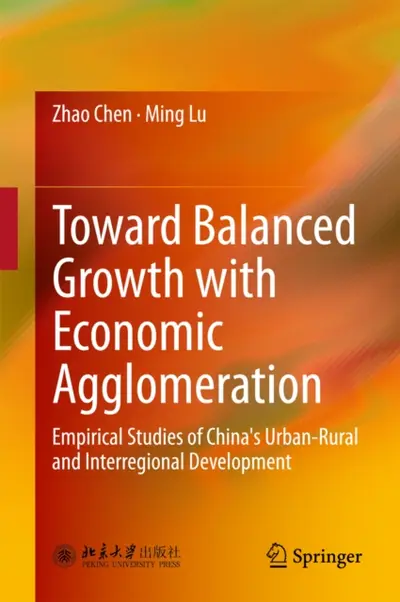
Toward Balanced Growth with Economic Agglomeration
Empirical Studies of China''s Urban-Rural and Interregional Development
Price and availability
$60.99
Available in: Andorra, Austria, Australia, Belgium, Bulgaria, Canada, Switzerland, Cyprus, Czechia, Germany, Denmark, Estonia, Spain, Finland, France, United Kingdom, Guernsey, Greece, Croatia, Hungary, Ireland, Isle of Man, Iceland, Italy, Jersey, Japan, Liechtenstein, Lithuania, Luxembourg, Latvia, Monaco, Malta, Netherlands, Norway, Poland, Portugal, Romania, Sweden, Slovenia, Slovakia, San Marino, United States, Vatican City, South Africa
Stores: US, UK, Canada, EU, Australia.
Sign in to buyThe price is re-checked by the server before payment.
For personal use under the eBook licence.
- Format
- DRM
- Not stated by the publisher
- Language
- English
- Publisher
- Springer Berlin Heidelberg
- Published
- 12 June 2015
- ISBN
- 9783662474129
- Subjects
- Economic growth, Development economics & emerging economies, Political economy, Economic growth, Political economy
About this book
This book explains the relationships between equality and efficiency, as well as between government and market, in urban-rural and regional development by providing theoretical frameworks and empirical evidence. Urban-rural development in China is understood from a regional perspective, while the core issue of urban-rural and regional development is cross-regional resource reallocation driven by the trends of globalization, marketization and urbanization and their influence on growth and inequality. The book puts forward the following arguments: An urban-rural and regional balance should not be achieved by limiting agglomeration effects in eastern regions. For some time now, China has lacked a suitable mechanism to enable residents in underdeveloped and rural areas to share in the achievements of economic agglomeration. As a result, China should not slow down economic agglomeration and development in eastern regions simply by depending on administrative means to balance urban-rural and regional development. In the final analysis, arriving at a regional balance depends on growth in the eastern regions, provided a reasonable mechanism is implemented to enable inland areas to share in the development achievements of eastern regions. In turn, finding an urban-regional balance rests on urban development, as long as more rural workers can move to and prosper in cities.
Bibliographic data © Gardners Books Ltd.