EPUB · English
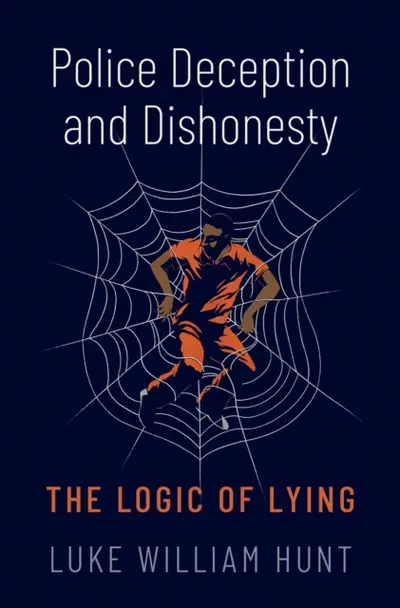
Police Deception and Dishonesty
The Logic of Lying
Price and availability
$22.99
Available in: Andorra, Austria, Australia, Belgium, Bulgaria, Canada, Switzerland, Cyprus, Czechia, Germany, Denmark, Estonia, Spain, Finland, France, United Kingdom, Guernsey, Greece, Croatia, Hungary, Ireland, Isle of Man, Iceland, Italy, Jersey, Japan, Liechtenstein, Lithuania, Luxembourg, Latvia, Monaco, Malta, Netherlands, Norway, Poland, Portugal, Romania, Sweden, Slovenia, Slovakia, San Marino, United States, Vatican City, South Africa
Stores: US, UK, Canada, EU, Australia.
Sign in to buyThe price is re-checked by the server before payment.
For personal use under the eBook licence.
- Format
- EPUB
- DRM
- Not stated by the publisher
- Language
- English
- Publisher
- Oxford University Press
- Published
- 19 December 2022
- ISBN
- 9780197672181
- Subjects
- Ethics & moral philosophy, Social & political philosophy, Jurisprudence & philosophy of law, Methods, theory and philosophy of law, QDTQ, QDTS
About this book
Cooperative relations steeped in honesty and good faith are a necessity for any viable society. This is especially relevant to the police institution because the police are entrusted to promote justice and security. Despite the necessity of societal honesty and good faith, the police institution has embraced deception, dishonesty, and bad faith as tools of the trade for providing security. In fact, it seems that providing security is impossible without using deception and dishonesty during interrogations, undercover operations, pretextual detentions, and other common scenarios. This presents a paradox related to the erosion of public faith in the police institution and the weakening of the police's legitimacy. In Police Deception and Dishonesty, Luke William Hunt--a philosophy professor and former FBI Special Agent--seeks to solve this puzzle by showing that many of our assumptions about policing and security are unjustified. Specifically, they are unjustified in the way many of our assumptions about security were unjustified after the 9/11 terrorist attacks, when state institutions embraced a variety of brutal rules and tactics in pursuit of perceived security enhancements. The police are likewise unjustified in their pursuit of many supposed security enhancements that rely on proactive deception, dishonesty, and bad faith. Hunt shows that there are compelling reasons to think that the police's widespread use of proactive deception and dishonesty is inconsistent with fundamental norms of political morality regarding fraud and the rule of law. Although there are times and places for dishonesty and deception in policing, Hunt evocatively illustrates why those times and places should be much more limited than current practices suggest.
Bibliographic data © Gardners Books Ltd.