PDF · English
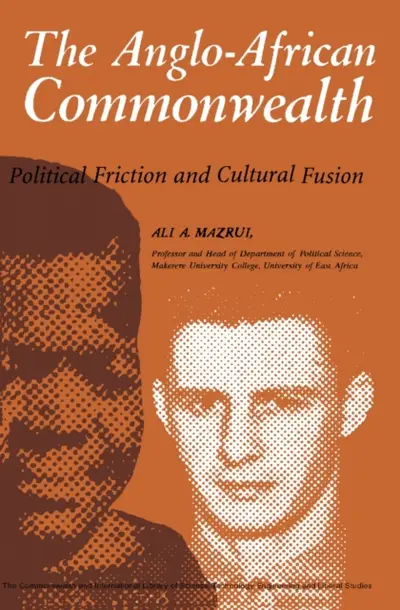
Anglo-African Commonwealth
Political Friction and Cultural Fusion
Price and availability
$27.99
Available in: Andorra, Austria, Australia, Belgium, Bulgaria, Canada, Switzerland, Cyprus, Czechia, Germany, Denmark, Estonia, Spain, Finland, France, United Kingdom, Guernsey, Greece, Croatia, Hungary, Ireland, Isle of Man, Iceland, Italy, Jersey, Japan, Liechtenstein, Lithuania, Luxembourg, Latvia, Monaco, Malta, Netherlands, Norway, Poland, Portugal, Romania, Sweden, Slovenia, Slovakia, San Marino, United States, Vatican City, South Africa
Stores: US, UK, Canada, EU, Australia.
Sign in to buyThe price is re-checked by the server before payment.
For personal use under the eBook licence.
- Format
- DRM
- Not stated by the publisher
- Language
- English
- Publisher
- Elsevier Science
- Published
- 22 October 2013
- ISBN
- 9781483160382
- Subjects
- Politics & government, International relations, Politics and government, International relations
About this book
The Anglo-African Commonwealth: Political Friction and Cultural Fusion deals with political friction and cultural fusion in the Anglo-African Commonwealth. Topics covered range from the history and politics of the Anglo-African Commonwealth as well as culture and thought, with emphasis on the Rhodesian problem and the Kenyan precedent, as well as the European Economic Community and the British legacy in Africa. The royal theme in African nationalism and the place of William Shakespeare in African political thought are also discussed. Comprised of eight chapters, this book begins with an analysis of the influence of Britain and of nationalism in Asia on the development of African resistance to colonial rule. It then examines the growth of African influence in the Conmmonwealth and some of the issues involved in the Rhodesian problem, along with Kenya's background of powerful white settlers. Subsequent chapters explore the development of the European Economic Community and its implications for Commonwealth Africa; Anglo-African self-conceptions, paying particular attention to the pre-eminent characteristic which the Africans and the British attribute to themselves; and the impact of the English language and English literature on African nationalism. The final chapter offers a reading of Julius Nyerere's translation of Shakespeare's Julius Caesar into Swahili and its significance both for Swahili literature and for African politics at large. This monograph will appeal to historians and political scientists.
Bibliographic data © Gardners Books Ltd.