PDF · English
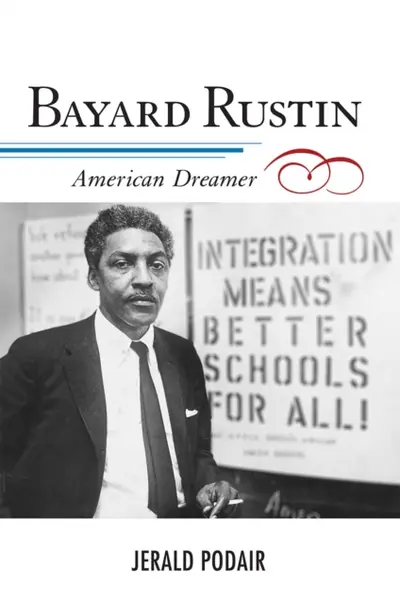
Bayard Rustin
American Dreamer
Price and availability
$54.99
Available in: Andorra, Austria, Australia, Belgium, Bulgaria, Canada, Switzerland, Cyprus, Czechia, Germany, Denmark, Estonia, Spain, Finland, France, United Kingdom, Guernsey, Greece, Croatia, Hungary, Ireland, Isle of Man, Iceland, Italy, Jersey, Japan, Liechtenstein, Lithuania, Luxembourg, Latvia, Monaco, Malta, Netherlands, Norway, Poland, Portugal, Romania, Sweden, Slovenia, Slovakia, San Marino, United States, Vatican City, South Africa
Stores: US, UK, Canada, EU, Australia.
Sign in to buyThe price is re-checked by the server before payment.
For personal use under the eBook licence.
- Format
- DRM
- Not stated by the publisher
- Language
- English
- Publisher
- Bloomsbury Publishing (USA)
- Published
- 16 December 2008
- Pages
- 128
- ISBN
- 9780742564800
- Subjects
- The Americas, North America, USA, Modern period, c 1500 onwards, 20th century, Biography: historical, political & military, History of the Americas, Social & cultural history, The Americas, North America (USA and Canada), United States of America, USA, 3M, 3MP, DNBH, NHK, NHTB
About this book
Bayard Rustin was a unique twentieth-century American radical voice. A homosexual, World War II draft resister, and ex-communist, he made enormous contributions to the civil rights, socialist, labor, peace, and gay rights movements in the United States, despite being viewed as an "e;outsider"e; even by fellow activists. Rustin was a humanist who championed the disadvantaged and oppressed, regardless of identity. In Bayard Rustin: American Dreamer, Jerald Podair examines the life and career of a man who shaped virtually every aspect of the modern civil rights movement as a theorist, strategist, and spokesman. Podair begins by covering the period from Rustin's 1912 birth in West Chester, Pennsylvania, to his 1946 release from federal prison, where he served over two years for draft evasion. After his release, Rustin threw himself into work on behalf of pacifism and racial integration, two goals that, at this stage of his career, fit together almost seamlessly. Podair goes on to examine Rustin's role as the main organizer of the 1963 March on Washington, the most important civil rights demonstration in American history. He was a major influence on Martin Luther King, Jr.'s philosophy of nonviolent direct action, which led to the strategy that changed the course of American race relations. During the last years of his life, Rustin continued to champion the causes of socialism, coalition politics, and racial integration, as he also sought to aid oppressed people and foster democratic institutions worldwide. Yet for all this, Rustin was rarely permitted a leading role in the movements he helped to shape. Because of his sexuality and his background as a former communist and draft resister, he was forced to do much of his work on the fringes, offering his organizational, strategic, and rhetorical skills to public leaders who chose to keep him at arm's length. Despite this, as Podair makes clear, Bayard Rustin was one of the most important civil rights leaders-and one of the most important radical leaders-in twentieth-century American history. Documents in this book include excerpts from Rustin's writings, speeches, and public statements.
Bibliographic data © Gardners Books Ltd.