PDF · English
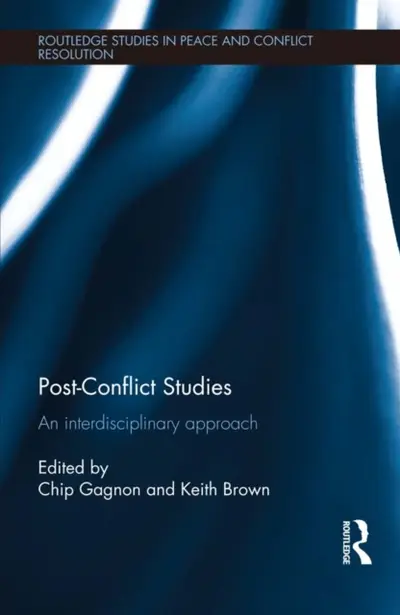
Post-Conflict Studies
An Interdisciplinary Approach
Price and availability
$63.99
Available in: Andorra, Austria, Australia, Belgium, Bulgaria, Canada, Switzerland, Cyprus, Czechia, Germany, Denmark, Estonia, Spain, Finland, France, United Kingdom, Guernsey, Greece, Croatia, Hungary, Ireland, Isle of Man, Iceland, Italy, Jersey, Japan, Liechtenstein, Lithuania, Luxembourg, Latvia, Monaco, Malta, Netherlands, Norway, Poland, Portugal, Romania, Sweden, Slovenia, Slovakia, San Marino, United States, Vatican City, South Africa
Stores: US, UK, Canada, EU, Australia.
Sign in to buyThe price is re-checked by the server before payment.
For personal use under the eBook licence.
- Format
- DRM
- Not stated by the publisher
- Language
- English
- Publisher
- Taylor & Francis
- Published
- 11 July 2014
- ISBN
- 9781317801740
- Subjects
- Peace studies & conflict resolution, Military history, Politics & government, International relations, Armed conflict, Warfare & defence, Peace studies and conflict resolution, International relations, Public international law: human rights
About this book
This book examines how the violence of conflict is transformed in the post-conflict period.Post-conflict studies seek to illuminate, theorise, and narrate the processes by which societies transition from periods of overt and violent conflict to periods of relative stability and peace. Most of the research carried out on post-conflict societies has taken place within disciplinary bounds. In contrast, this volume breaches those boundaries; though each author is grounded in a particular discipline, the chapters have been written in a spirit of interdisciplinarity.The focus of the volume is how the violence of conflict is transformed in the post-conflict period into processes that the editors have categorised as criminalisation, medicalisation and missionisation. Comprised of essays written by a diverse group of scholars and activists from anthropology, political science, international relations, law, education, religion, and military history, each section of the book looks at the concept of post-conflict in a way that problematises its common usage and highlights the importance of strongly interdisciplinary research into post-conflict societies.This book will be of interest to students of war and conflict studies, peace studies, security studies and IR in general.
Bibliographic data © Gardners Books Ltd.