EPUB · English
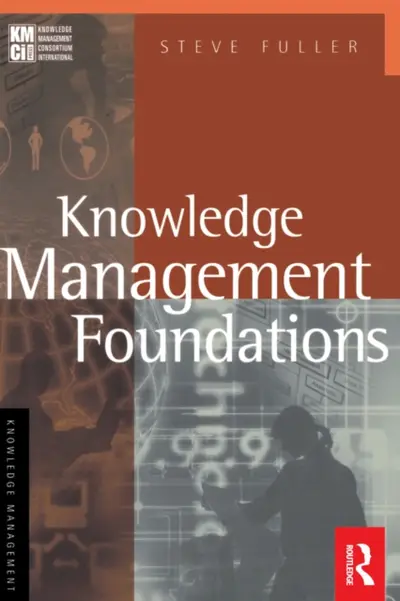
Knowledge Management Foundations
Price and availability
$72.99
Available in: Andorra, Austria, Australia, Belgium, Bulgaria, Canada, Switzerland, Cyprus, Czechia, Germany, Denmark, Estonia, Spain, Finland, France, United Kingdom, Guernsey, Greece, Croatia, Hungary, Ireland, Isle of Man, Iceland, Italy, Jersey, Japan, Liechtenstein, Lithuania, Luxembourg, Latvia, Monaco, Malta, Netherlands, Norway, Poland, Portugal, Romania, Sweden, Slovenia, Slovakia, San Marino, United States, Vatican City, South Africa
Stores: US, UK, Canada, EU, Australia.
Sign in to buyThe price is re-checked by the server before payment.
For personal use under the eBook licence.
- Format
- EPUB
- DRM
- Not stated by the publisher
- Language
- English
- Publisher
- Taylor & Francis
- Published
- 26 July 2012
- ISBN
- 9781136389818
- Subjects
- Philosophy: epistemology & theory of knowledge, Management decision making, Knowledge management, Higher education, tertiary education, Organizational theory and behaviour, Applied computing
About this book
'Knowledge Management Foundations' is just what it claims, the first attempt to provide a secure intellectual footing for the myriad of practices called "e;knowledge management."e; A breath of fresh air from the usual KM gurus, Fuller openly admits that the advent of KM is a mixed blessing that often amounts to the conduct of traditional management by subtler means. However, Fuller's deep understanding of both the history of management theory and knowledge production more generally enables him to separate the wheat from the chaff of the KM literature. This ground-breaking book will prove of interest to both academics and practitioners of knowledge management. It highlights the ways in which KM has challenged the values associated with knowledge that academics have taken for granted for centuries. At the same time, Fuller resists the conclusion of many KM gurus, that the value of knowledge lies in whatever the market will bear in the short term. He pays special attention to how information technology has not only facilitated knowledge work but also has radically altered its nature. There are chapters devoted to the revolution in intellectual property and an evaluation of peer review as a quality control mechanism. The book culminates in a positive re-evaluation of universities as knowledge producing institutions from which the corporate sector still has much to learn.
Bibliographic data © Gardners Books Ltd.