EPUB · English
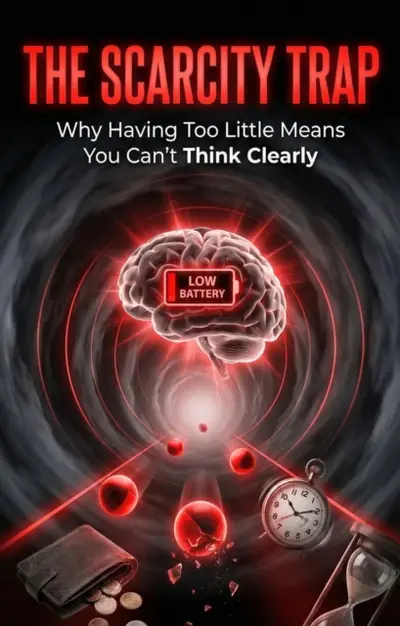
Scarcity Trap
Why Having Too Little Means You Can''t Think Clearly
Price and availability
$5.99
Available in: Andorra, Austria, Australia, Belgium, Bulgaria, Canada, Switzerland, Cyprus, Czechia, Germany, Denmark, Estonia, Spain, Finland, France, United Kingdom, Guernsey, Greece, Croatia, Hungary, Ireland, Isle of Man, Iceland, Italy, Jersey, Japan, Liechtenstein, Lithuania, Luxembourg, Latvia, Monaco, Malta, Netherlands, Norway, Poland, Portugal, Romania, Sweden, Slovenia, Slovakia, San Marino, United States, Vatican City, South Africa
Stores: US, UK, Canada, EU, Australia.
Sign in to buyThe price is re-checked by the server before payment.
For personal use under the eBook licence.
- Format
- EPUB
- DRM
- Not stated by the publisher
- Language
- English
- Publisher
- epubli
- Published
- 18 February 2026
- ISBN
- 9783565257232
- Subjects
- Cognition & cognitive psychology, Cognition and cognitive psychology
About this book
Why do poor people take payday loans with 400% interest? Why do busy executives make terrible decisions about their health? We often blame these behaviors on a lack of discipline or education. But behavioral economist Sendhil Mullainathan and psychologist Eldar Shafir propose a different, radical theory: Scarcity itself lowers your IQ. "e;The Scarcity Trap"e; explains that when your brain is obsessed with a lack of something whether it's money, time, or calories it "e;tunnels"e; on that immediate problem. This tunneling consumes massive amounts of cognitive bandwidth, effectively dropping your fluid intelligence by up to 13 points (equivalent to a night without sleep). This book explores how this "e;bandwidth tax"e; leads to a vicious cycle of bad decisions that perpetuate the scarcity. It moves the conversation from "e;character flaws"e; to "e;design flaws"e; in our environment and offers structural solutions for escaping the trap. Whether you are drowning in debt or drowning in work, the psychology is the same: your brain is processing a shortage, not a life.
Bibliographic data © Gardners Books Ltd.