PDF · English
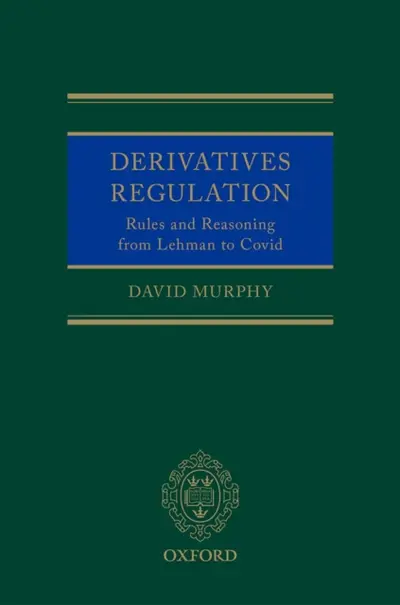
Derivatives Regulation
Rules and Reasoning from Lehman to Covid
Price and availability
$97.99
Available in: Andorra, Austria, Australia, Belgium, Bulgaria, Canada, Switzerland, Cyprus, Czechia, Germany, Denmark, Estonia, Spain, Finland, France, United Kingdom, Guernsey, Greece, Croatia, Hungary, Ireland, Isle of Man, Iceland, Italy, Jersey, Japan, Liechtenstein, Lithuania, Luxembourg, Latvia, Monaco, Malta, Netherlands, Norway, Poland, Portugal, Romania, Sweden, Slovenia, Slovakia, San Marino, United States, Vatican City, South Africa
Stores: US, UK, Canada, EU, Australia.
Sign in to buyThe price is re-checked by the server before payment.
For personal use under the eBook licence.
- Format
- DRM
- Not stated by the publisher
- Language
- English
- Publisher
- Oxford University Press
- Published
- 3 March 2022
- ISBN
- 9780192661814
- Subjects
- Economics, Banking law, Capital markets & securities law & regulation, Economics, Banking law, Capital markets and securities law and regulation
About this book
Derivatives Regulation - Rules and Reasoning from Lehman to Covid provides an indepth examination of the changes made to the regulation of derivatives that were enacted following the global financial crisis of 2008, considering the motivations behind these changes and including insights from the Covid pandemic. Key areas of derivatives regulatory reform are examined, including bank capital and leverage rules, the clearing mandate, uncleared margin rules, and the principles for the regulation of central counterparties. After providing an overview of the global financial crisis, the motivations for these reforms in its immediate aftermath are considered, as well as the impact of these rules on the financial system, using insights from the market stress around the onset of the Covid pandemic in 2020. The book analyses the construction of financial regulation, as well as its nature and how this should be assessed, using tools from the law, economics, and regulatory theory. Global administrative law, cost benefit analysis, and the results of regulatory interventions in other areas throw light on the legitimacy, efficiency, and effectiveness of derivatives regulation. Insights from international political economy are also discussed, situating financial regulation within the regulatory state, while showing how its institutional arrangements shape regulatory outcomes. Suggestions for improving both rules and regulatory processes are considered in the conclusion of the book.
Bibliographic data © Gardners Books Ltd.