EPUB · English
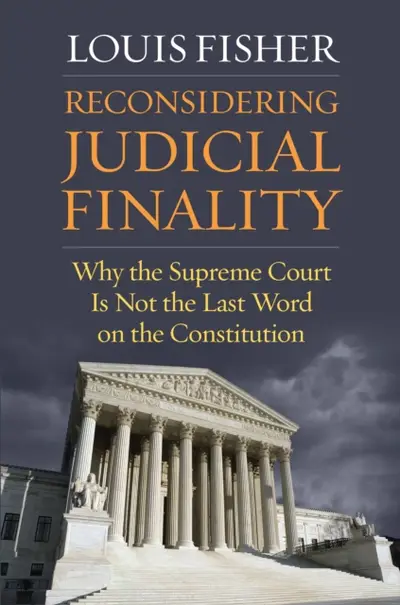
Reconsidering Judicial Finality
Why the Supreme Court Is Not the Last Word on the Constitution
Price and availability
$31.99
Available in: Andorra, Austria, Australia, Belgium, Bulgaria, Canada, Switzerland, Cyprus, Czechia, Germany, Denmark, Estonia, Spain, Finland, France, United Kingdom, Guernsey, Greece, Croatia, Hungary, Ireland, Isle of Man, Iceland, Italy, Jersey, Japan, Liechtenstein, Lithuania, Luxembourg, Latvia, Monaco, Malta, Netherlands, Norway, Poland, Portugal, Romania, Sweden, Slovenia, Slovakia, San Marino, United States, Vatican City, South Africa
Stores: US, UK, Canada, EU, Australia.
Sign in to buyThe price is re-checked by the server before payment.
For personal use under the eBook licence.
- Format
- EPUB
- DRM
- Not stated by the publisher
- Language
- English
- Publisher
- University Press of Kansas
- Published
- 11 October 2019
- ISBN
- 9780700628117
- Subjects
- USA, History of the Americas, Constitution: government & the state, Courts & procedure, Constitution: government and the state, Central / national / federal government, History of the Americas
About this book
Federal judges, legal scholars, pundits, and reporters frequently describe the Supreme Court as the final word on the meaning of the Constitution. The historical record presents an entirely different picture. A close and revealing reading of that record, from 1789 to the present day, Reconsidering Judicial Finality reminds us of the unalterable fact, as Chief Justice Rehnquist once remarked, that our judicial system, like the human beings who administer it, is fallible. And a Court inevitably prone to miscalculation and error, as this book clearly demonstrates, cannot have the incontrovertible last word on constitutional questions.In this deeply researched, sharply reasoned work of legal myth-busting, constitutional scholar Louis Fisher explains how constitutional disputes are settled by all three branches of government, and by the general public, with the Supreme Court often playing a secondary role. The Courts decisions have, of course, been challenged and reversed in numerous casesinvolving slavery, civil rights, child labor legislation, Japanese internment during World War II, abortion, and religious liberty. What Fisher shows us on a case-by-case basis is how the elected branches, scholars, and American public regularly press policies contrary to Court rulingsand regularly prevail, although the process might sometimes take decades. From the common misreading of Marbury v. Madison, to the mistaken understanding of the Supreme Court as the trusted guardian of individual rights, to the questionable assumptions of the Courts decision in Citizens United, Fishers work charts the distance and the difference between the Court as the ultimate arbiter in constitutional matters and the judgment of history.The verdict of Reconsidering Judicial Finality is clear: to treat the Supreme Courts nine justices as democracys last hope or as dangerous activists undermining democracy is to vest them with undue significance. The Constitution belongs to all three branches of governmentand, finally, to the American people.
Bibliographic data © Gardners Books Ltd.