PDF · English
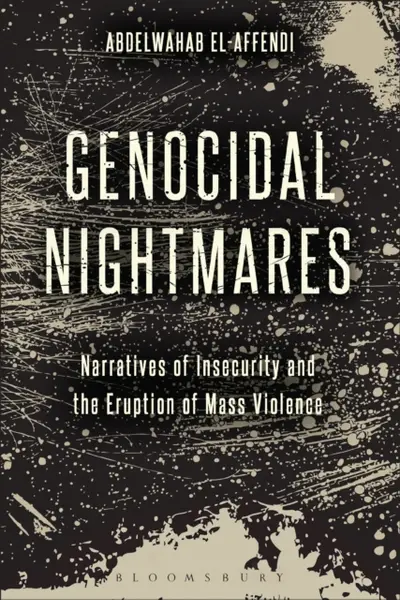
Genocidal Nightmares
Narratives of Insecurity and the Logic of Mass Atrocities
Price and availability
$47.99
Available in: Andorra, Austria, Australia, Belgium, Bulgaria, Canada, Switzerland, Cyprus, Czechia, Germany, Denmark, Estonia, Spain, Finland, France, United Kingdom, Guernsey, Greece, Croatia, Hungary, Ireland, Isle of Man, Iceland, Italy, Jersey, Japan, Liechtenstein, Lithuania, Luxembourg, Latvia, Monaco, Malta, Netherlands, Norway, Poland, Portugal, Romania, Sweden, Slovenia, Slovakia, San Marino, United States, Vatican City, South Africa
Stores: US, UK, Canada, EU, Australia.
Sign in to buyThe price is re-checked by the server before payment.
For personal use under the eBook licence.
- Format
- DRM
- Not stated by the publisher
- Language
- English
- Publisher
- Bloomsbury Publishing (USA)
- Published
- 20 November 2014
- Pages
- 288
- ISBN
- 9781628920758
- Subjects
- General & world history, Genocide & ethnic cleansing, International relations, Terrorism, armed struggle, International relations, Terrorism, armed struggle, NHB, NHTZ
About this book
This book offers a novel and productive explanation of why 'ordinary' people can be moved to engage in destructive mass violence (or terrorism and the abuse of rights), often in large numbers and in unexpected ways. Its argument is that narratives of insecurity (powerful horror stories people tell and believe about their world and others) can easily make extreme acts appear acceptable, even necessary and heroic. As in action or horror movies, the script dictates how the 'hero' acts. The book provides theoretical justifications for this analysis, building on earlier studies but going beyond them in what amount to a breakthrough in mapping the context of mass violence. It backs its argument with a large number of case studies covering four continents, written by prominent scholars from the relevant countries or with deep knowledge of them. A substantial introduction by the UN's Special Advisor on the Prevention of Genocide demonstrates the policy relevance of this path-breaking work.
Bibliographic data © Gardners Books Ltd.