EPUB · English
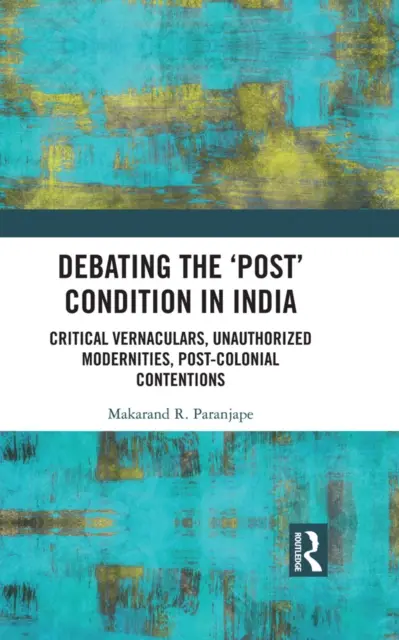
Debating the 'Post' Condition in India
Critical Vernaculars, Unauthorized Modernities, Post-Colonial Contentions
Price and availability
$63.99
Available in: Andorra, Austria, Australia, Belgium, Bulgaria, Canada, Switzerland, Cyprus, Czechia, Germany, Denmark, Estonia, Spain, Finland, France, United Kingdom, Guernsey, Greece, Croatia, Hungary, Ireland, Isle of Man, Iceland, Italy, Jersey, Japan, Liechtenstein, Lithuania, Luxembourg, Latvia, Monaco, Malta, Netherlands, Norway, Poland, Portugal, Romania, Sweden, Slovenia, Slovakia, San Marino, United States, Vatican City, South Africa
Stores: US, UK, Canada, EU, Australia.
Sign in to buyThe price is re-checked by the server before payment.
For personal use under the eBook licence.
- Format
- EPUB
- DRM
- Not stated by the publisher
- Language
- English
- Publisher
- Taylor & Francis
- Published
- 25 October 2017
- ISBN
- 9781351583596
- Subjects
- Asia, Indian sub-continent, India, Modern Indic languages, Literary theory, Literary studies: post-colonial literature, Regional studies, Oriental & Indian philosophy, Cultural studies, India, Comparative literature, Cultural studies, East Asian and Indian philosophy
About this book
How was the post-modernist project contested, subverted and assimilated in India? This book offers a personal account and an intellectual history of its reception and response. Tracing independent India's engagement with Western critical theory, Paranjape outlines both its past and 'post'. The book explores the discursive trajectories of post-modernism, post-colonialism, post-Marxism, post-nationalism, post-feminism, post-secularism - the relations that mediate them - as well as interprets, in the light of these discussions, core tenets of Indian philosophical thought. Paranjape argues that India's response to the modernist project is neither submission, willing or reluctant, nor repudiation, intentional or forced; rather India's 'modernity' is 'unauthorized', different, subversive, alter-native and alter-modern. The book makes the case for a new integrative hermeneutics, the idea of the indigenous 'critical vernacular', and presents a radical shift in the understanding of svaraj (beyond decolonisation and nationalism) to express transformations at both personal and political levels. A key intervention in Indian critical theory, this volume will interest researchers and scholars of literature, philosophy, political theory, culture studies and postcolonial studies.
Bibliographic data © Gardners Books Ltd.