PDF · root
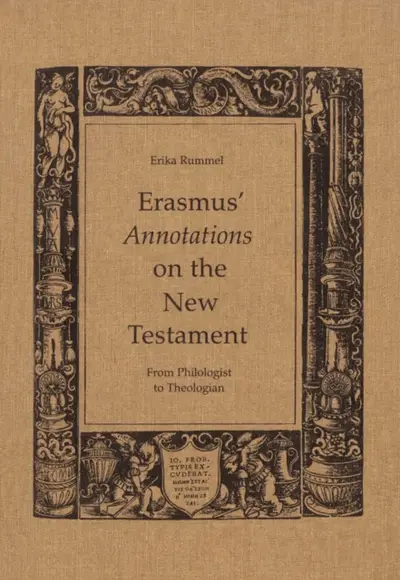
Erasmus' Annotations on the New Testament
From Philologist to Theologian
Price and availability
$66.99
Available in: Andorra, Austria, Australia, Belgium, Bulgaria, Canada, Switzerland, Cyprus, Czechia, Germany, Denmark, Estonia, Spain, Finland, France, United Kingdom, Guernsey, Greece, Croatia, Hungary, Ireland, Isle of Man, Iceland, Italy, Jersey, Japan, Liechtenstein, Lithuania, Luxembourg, Latvia, Monaco, Malta, Netherlands, Norway, Poland, Portugal, Romania, Sweden, Slovenia, Slovakia, San Marino, United States, Vatican City, South Africa
Stores: US, UK, Canada, EU, Australia.
Sign in to buyThe price is re-checked by the server before payment.
For personal use under the eBook licence.
- Format
- DRM
- Not stated by the publisher
- Language
- root
- Publisher
- University of Toronto Press
- Published
- 1 November 1986
- Pages
- 234
- ISBN
- 9781442674530
- Subjects
- Europe, Modern period, c 1500 onwards, History, European history, Early modern history: c 1450/1500 to c 1700, Archaeology, Islamic & Arabic philosophy, Philosophy of religion, Religious issues & debates, Christian theology, 3M, NH, NHD, NK, QDHK, QRAB, QRAM, QRM
About this book
Without the notes, Erasmus said, the texts of the Scripture were 'naked and defenceless,' open to criticism by uncomprehending readers and corruption by careless printers. The Annotations represent not only Erasmus' defence of the New Testament against such abuss, but also a reflection of his own philosophy, objectives, and working methods. In establishing the text and defending it against his opponents, Erasmus drew on manuscript sources, classical literature, patristic writings, scholastic exegesis, and the work of his immediate forerunners, Valla and Lefevre. He did not hesitate to point out the errors of illustrious writers like Jerome and established medieval authorities like Peter Lombard. In general he was appreciative of the early church Fathers and contemptuous of medieval commentators. As well as discussing the contents and aims of the Annotations, Erika Rummel investigates Erasmus' development from philologist to theologian and traces the prepublication history of the New Testament. She examines the critical reaction of conservative theologians to Erasmus' work and his replies, incorporated in later editions of the Annotations. The book ends by suggesting a wider field of research: the relationship between the Annotations and the corpus of Erasmian apologetic works.
Bibliographic data © Gardners Books Ltd.