PDF · English
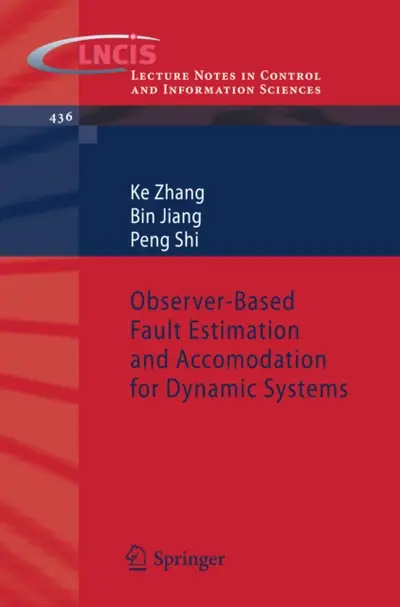
Observer-Based Fault Estimation and Accomodation for Dynamic Systems
Price and availability
$120.99
Available in: Andorra, Austria, Australia, Belgium, Bulgaria, Canada, Switzerland, Cyprus, Czechia, Germany, Denmark, Estonia, Spain, Finland, France, United Kingdom, Guernsey, Greece, Croatia, Hungary, Ireland, Isle of Man, Iceland, Italy, Jersey, Japan, Liechtenstein, Lithuania, Luxembourg, Latvia, Monaco, Malta, Netherlands, Norway, Poland, Portugal, Romania, Sweden, Slovenia, Slovakia, San Marino, United States, Vatican City, South Africa
Stores: US, UK, Canada, EU, Australia.
Sign in to buyThe price is re-checked by the server before payment.
For personal use under the eBook licence.
- Format
- DRM
- Not stated by the publisher
- Language
- English
- Publisher
- Springer Berlin Heidelberg
- Published
- 16 October 2012
- ISBN
- 9783642339868
- Subjects
- Cybernetics & systems theory, Engineering: general, Maths for engineers, Electrical engineering, Automatic control engineering, Cybernetics and systems theory, Maths for engineers, Automatic control engineering
About this book
Due to the increasing security and reliability demand of actual industrial process control systems, the study on fault diagnosis and fault tolerant control of dynamic systems has received considerable attention. Fault accommodation (FA) is one of effective methods that can be used to enhance system stability and reliability, so it has been widely and in-depth investigated and become a hot topic in recent years.Fault detection is used to monitor whether a fault occurs, which is the first step in FA. On the basis of fault detection, fault estimation (FE) is utilized to determine online the magnitude of the fault, which is a very important step because the additional controller is designed using the fault estimate. Compared with fault detection, the design difficulties of FE would increase a lot, so research on FE and accommodation is very challenging. Although there have been advancements reported on FE and accommodation for dynamic systems, the common methods at the present stage have design difficulties, which limit applications of respective design approaches.Therefore, the problems of FE and accommodation are needed to be further studied. This book considers the theory and technology of FE and accommodation for dynamic systems, and establishes a systemic and comprehensive framework of FE and accommodation for continuous/discrete-time systems.
Bibliographic data © Gardners Books Ltd.