PDF · English
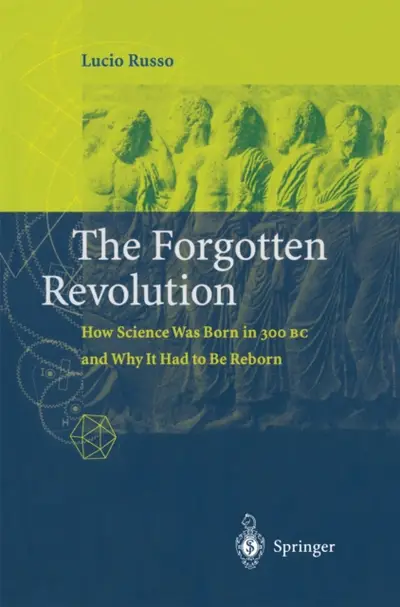
Forgotten Revolution
How Science Was Born in 300 BC and Why it Had to Be Reborn
Price and availability
$189.99
Available in: Andorra, Austria, Australia, Belgium, Bulgaria, Canada, Switzerland, Cyprus, Czechia, Germany, Denmark, Estonia, Spain, Finland, France, United Kingdom, Guernsey, Greece, Croatia, Hungary, Ireland, Isle of Man, Iceland, Italy, Jersey, Japan, Liechtenstein, Lithuania, Luxembourg, Latvia, Monaco, Malta, Netherlands, Norway, Poland, Portugal, Romania, Sweden, Slovenia, Slovakia, San Marino, United States, Vatican City, South Africa
Stores: US, UK, Canada, EU, Australia.
Sign in to buyThe price is re-checked by the server before payment.
For personal use under the eBook licence.
- Format
- DRM
- Not stated by the publisher
- Language
- English
- Publisher
- Springer Berlin Heidelberg
- Published
- 1 December 2013
- ISBN
- 9783642189043
- Subjects
- Ancient Greece, History of mathematics, Science: general issues, History of science, Biology, life sciences, Technology: general issues, Miscellaneous items, Interdisciplinary studies, Mathematics and Science, History of mathematics, History of science, Life sciences: general issues, Engineering: general
About this book
The period from the late fourth to the late second century B. C. witnessed, in Greek-speaking countries, an explosion of objective knowledge about the external world. WhileGreek culture had reached great heights in art, literature and philosophyalreadyin the earlier classical era, it is in the so-called Hellenistic period that we see for the ?rst time - anywhere in the world - the appearance of science as we understand it now: not an accumulation of facts or philosophically based speculations, but an or- nized effort to model nature and apply such models, or scienti?ctheories in a sense we will make precise, to the solution of practical problems and to a growing understanding of nature. We owe this new approach to scientists such as Archimedes, Euclid, Eratosthenes and many others less familiar todaybut no less remarkable. Yet, not long after this golden period, much of this extraordinary dev- opment had been reversed. Rome borrowed what it was capable of from the Greeks and kept it for a little while yet, but created very little science of its own. Europe was soon smothered in theobscurantism and stasis that blocked most avenues of intellectual development for a thousand years - until, as is well known, the rediscovery of ancient culture in its fullness paved the way to the modern age.
Bibliographic data © Gardners Books Ltd.