PDF · English
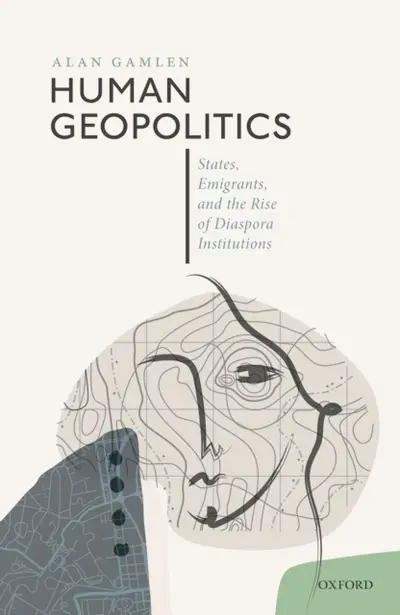
Human Geopolitics
States, Emigrants, and the Rise of Diaspora Institutions
Price and availability
$104.99
Available in: Andorra, Austria, Australia, Belgium, Bulgaria, Canada, Switzerland, Cyprus, Czechia, Germany, Denmark, Estonia, Spain, Finland, France, United Kingdom, Guernsey, Greece, Croatia, Hungary, Ireland, Isle of Man, Iceland, Italy, Jersey, Japan, Liechtenstein, Lithuania, Luxembourg, Latvia, Monaco, Malta, Netherlands, Norway, Poland, Portugal, Romania, Sweden, Slovenia, Slovakia, San Marino, United States, Vatican City, South Africa
Stores: US, UK, Canada, EU, Australia.
Sign in to buyThe price is re-checked by the server before payment.
For personal use under the eBook licence.
- Format
- DRM
- Not stated by the publisher
- Language
- English
- Publisher
- Oxford University Press
- Published
- 2 May 2019
- ISBN
- 9780192569981
- Subjects
- Migration, immigration & emigration, International relations, Political economy, Political geography, Migration, immigration and emigration, International relations, Political economy
About this book
Human geopolitics, the competition for population rather than territory, is an essential but weakly understood dimension of world politics today. Such competition has preceded violent conflict throughout history, but has been muted since the Treaties of Westphalia laid the territorial foundations of the modern international system in the mid-seventeenth century. Today, however, human geopolitics is being resurrected in unanticipated ways, as governments are enabled and encouraged to engage their emigrant diasporas. How and why is this happening? Until now these questions have been difficult to answer. The majority of research attention has focused on questions of immigration policy in a handful of wealthy migrant destination countries, largely ignoring the emigration policies that preoccupy the worlds many migrant origin states. This book addresses that research imbalance, by focusing on the overlooked sending side of migration policy. Drawing on data covering all UN members across the post-WWII period, and fieldwork with high-level policy makers across 60 states and a dozen international organisations, the book charts the re-emergence of human geopolitics through the global spread of diaspora institutions government ministries and offices dedicated to emigrants and their descendants. It calls for the development of stronger guiding principles and evaluation frameworks to govern these new state-diaspora relations in an era of unprecedented global interdependence.
Bibliographic data © Gardners Books Ltd.