PDF · English
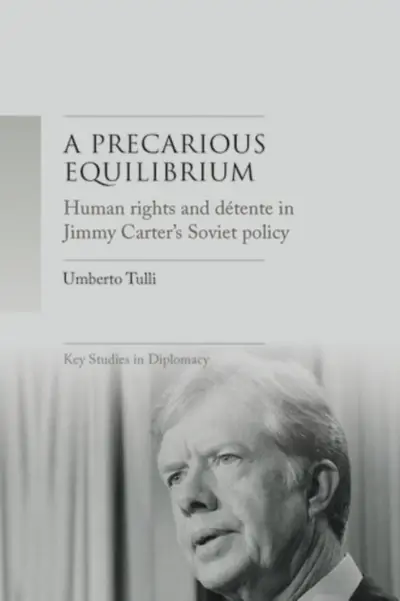
precarious equilibrium
Human rights and détente in Jimmy Carter''s Soviet policy
Price and availability
$27.99
Available in: Andorra, Austria, Australia, Belgium, Bulgaria, Canada, Switzerland, Cyprus, Czechia, Germany, Denmark, Estonia, Spain, Finland, France, United Kingdom, Guernsey, Greece, Croatia, Hungary, Ireland, Isle of Man, Iceland, Italy, Jersey, Japan, Liechtenstein, Lithuania, Luxembourg, Latvia, Monaco, Malta, Netherlands, Norway, Poland, Portugal, Romania, Sweden, Slovenia, Slovakia, San Marino, United States, Vatican City, South Africa
Stores: US, UK, Canada, EU, Australia.
Sign in to buyThe price is re-checked by the server before payment.
For personal use under the eBook licence.
- Format
- DRM
- Not stated by the publisher
- Language
- English
- Publisher
- Manchester University Press
- Published
- 28 February 2020
- ISBN
- 9781526146014
- Subjects
- Former Soviet Union, USSR (Europe), USA, c 1970 to c 1980, Comparative politics, International relations, Diplomacy, Human rights, Civil rights & citizenship, Comparative politics, International relations, Diplomacy
About this book
In January 1981, just days before Jimmy Carter left the White House, many of the president's officials were well satisfied with the administration's campaign to promote human rights. But as commentators, scholars, and the incoming president began to critique Carter's bipolar policy, it became clear that Carter had not only failed to persuade the American public that he had a clear grasp on the international role of the US, but he failed to build a lasting domestic consensus on foreign policy.The Carter administration aimed to renew its ideological challenge to the USSR through human rights and to persuade the Soviets to ease internal repression in order to strengthen Congressional support for detente and arms control. Contrary to what he envisioned, the more vigorously the White House pursued a pro-human rights agenda, the more the Soviets lost interest in detente; the more the administration relegated human rights to quiet diplomacy, the more critics within the United States accused the President of abandoning his commitment to human rights. In the end, the White House lost the opportunity to stabilise bipolar relations and the domestic support Carter had managed to garner in 1976. Critics of detente, helped by the Iran hostage crisis and the Soviet invasion of Afghanistan, defeated him.Based on recently declassified archival documents, A precarious equilibrium offers a fresh interpretation of President Jimmy Carter's human rights policy and its contradictory impact on US-Soviet affairs.
Bibliographic data © Gardners Books Ltd.