PDF · English
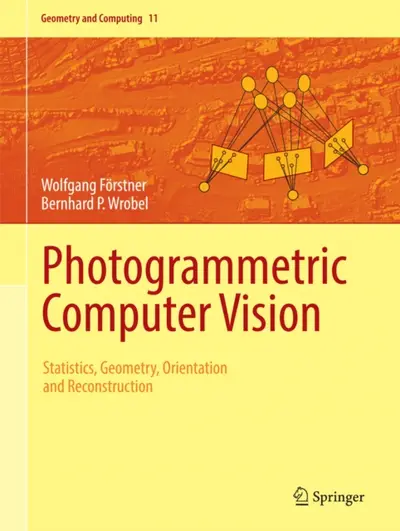
Photogrammetric Computer Vision
Statistics, Geometry, Orientation and Reconstruction
Price and availability
$74.99
Available in: Andorra, Austria, Australia, Belgium, Bulgaria, Canada, Switzerland, Cyprus, Czechia, Germany, Denmark, Estonia, Spain, Finland, France, United Kingdom, Guernsey, Greece, Croatia, Hungary, Ireland, Isle of Man, Iceland, Italy, Jersey, Japan, Liechtenstein, Lithuania, Luxembourg, Latvia, Monaco, Malta, Netherlands, Norway, Poland, Portugal, Romania, Sweden, Slovenia, Slovakia, San Marino, United States, Vatican City, South Africa
Stores: US, UK, Canada, EU, Australia.
Sign in to buyThe price is re-checked by the server before payment.
For personal use under the eBook licence.
- Format
- DRM
- Not stated by the publisher
- Language
- English
- Publisher
- Springer International Publishing
- Published
- 4 October 2016
- ISBN
- 9783319115504
- Subjects
- Geometry, Geography, Computer vision, Image processing, Geometry, Geographical information systems, geodata and remote sensing, Image processing
About this book
This textbook offers a statistical view on the geometry of multiple view analysis, required for camera calibration and orientation and for geometric scene reconstruction based on geometric image features. The authors have backgrounds in geodesy and also long experience with development and research in computer vision, and this is the first book to present a joint approach from the converging fields of photogrammetry and computer vision. Part I of the book provides an introduction to estimation theory, covering aspects such as Bayesian estimation, variance components, and sequential estimation, with a focus on the statistically sound diagnostics of estimation results essential in vision metrology. Part II provides tools for 2D and 3D geometric reasoning using projective geometry. This includes oriented projective geometry and tools for statistically optimal estimation and test of geometric entities and transformations and their rela-tions, tools that are useful also in the context of uncertain reasoning in point clouds. Part III is de-voted to modelling the geometry of single and multiple cameras, addressing calibration and orienta-tion, including statistical evaluation and reconstruction of corresponding scene features and surfaces based on geometric image features. The authors provide algorithms for various geometric computa-tion problems in vision metrology, together with mathematical justifications and statistical analysis, thus enabling thorough evaluations. The chapters are self-contained with numerous figures and exer-cises, and they are supported by an appendix that explains the basic mathematical notation and a de-tailed index.The book can serve as the basis for undergraduate and graduate courses in photogrammetry, com-puter vision, and computer graphics. It is also appropriate for researchers, engineers, and software developers in the photogrammetry and GIS industries, particularly those engaged with statistically based geometric computer vision methods.
Bibliographic data © Gardners Books Ltd.