PDF · English
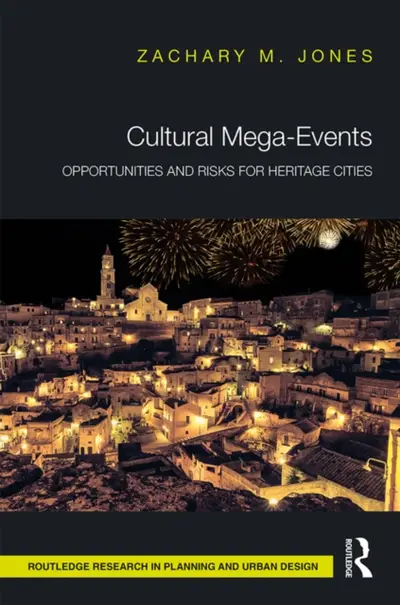
Cultural Mega-Events
Opportunities and Risks for Heritage Cities
- Economics, business & finance
- Nature, environment & geography
- Technology & engineering
- Arts, music & film
- Reference
- Sport & outdoors
Price and availability
$59.99
Available in: Andorra, Austria, Australia, Belgium, Bulgaria, Canada, Switzerland, Cyprus, Czechia, Germany, Denmark, Estonia, Spain, Finland, France, United Kingdom, Guernsey, Greece, Croatia, Hungary, Ireland, Isle of Man, Iceland, Italy, Jersey, Japan, Liechtenstein, Lithuania, Luxembourg, Latvia, Monaco, Malta, Netherlands, Norway, Poland, Portugal, Romania, Sweden, Slovenia, Slovakia, San Marino, United States, Vatican City, South Africa
Stores: US, UK, Canada, EU, Australia.
Sign in to buyThe price is re-checked by the server before payment.
For personal use under the eBook licence.
- Format
- DRM
- Not stated by the publisher
- Language
- English
- Publisher
- Taylor & Francis
- Published
- 5 March 2020
- ISBN
- 9781000028065
- Subjects
- Environmentally-friendly architecture & design, Landscape art & architecture, City & town planning - architectural aspects, Museology & heritage studies, Service industries, Tourism industry, Hospitality industry, Urban & municipal planning, Sports training & coaching, City and town planning: architectural aspects, Museology and heritage studies, Urban and municipal planning and policy, Civil engineering, surveying and building
About this book
Mega-events have long been used by cities as a strategy to secure global recognition and attract future economic investment. However, while cultural mega-events like the European Capital of Culture have become increasingly popular, cities have begun questioning the traditional model of other events such as the Olympic Games with many candidate cities cancelling bids in recent years. This approach to planning and developing cities through mega-events introduces a broad range of physical effects and nuanced institutional changes for cities, particularly for the more sensitive heritage areas of cities. This book explores these issues by first examining the dynamics of cities' attempts to reduce overall costs and increase the sustainability of these large events by further embedding them within the existing fabric of the city and second by studying in depth the impact on the heritage of host cities. This book investigates three World Heritage Cities: Genoa, Liverpool and Istanbul, each of which have hosted the European Capital of Culture and introduced a variety of opportunities and risks for their heritage. The book highlights the potential benefits and challenges of integrating event and heritage planning to provide lessons that can help future historic cities and heritage decision makers better prepare for such events.
Bibliographic data © Gardners Books Ltd.